
Author

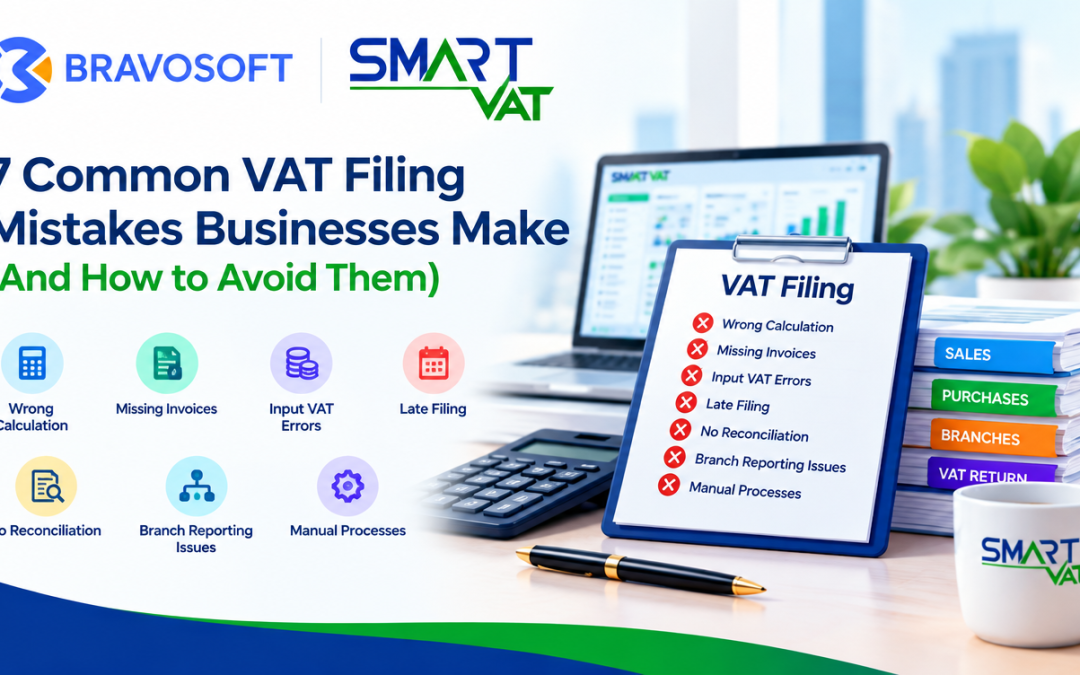
The 7 common VAT filing mistakes businesses make rarely look serious when they happen. A missing BIN on a supplier invoice, an outdated price list, a branch report that arrives a day late. Yet together they can mean rejected input credits, penalties and difficult audit conversations.
Picture a Dhaka retail business in the last week of the month. The accounts team pulls sales from the POS, purchase invoices from a shared folder and working sheets from three branches. The Mushak 9.1 return is due in days, and the numbers do not quite agree.
In Bangladesh, VAT is governed by the Value Added Tax and Supplementary Duty Act, 2012 (the VAT and SD Act) and administered by the National Board of Revenue (NBR). Filing depends on accurate records, correct calculation, valid documents and regular reconciliation, and businesses with high transaction volumes or several branches feel the strain most. Requirements vary by business category, transaction type and the legal provisions that apply, so confirm specifics with NBR or a qualified VAT professional.
Key VAT Terms in Simple Language
- Output VAT: VAT you charge customers. Input VAT: VAT you pay on purchases, which may be claimed as credit when legal conditions are met.
- BIN: the Business Identification Number issued on VAT registration.
- Mushak forms: prescribed forms under the VAT and SD Rules, 2016. Mushak 6.3 is the tax invoice and Mushak 9.1 is the VAT return.
- VDS: VAT deducted at source by a designated buyer and deposited with the government.
The 7 Common VAT Filing Mistakes Businesses Make at a Glance
- Incorrect VAT calculation
- Missing or incomplete VAT invoices
- Incorrect input VAT credit claims
- Missing VAT filing deadlines
- Failing to reconcile sales, purchases and VAT records
- Incorrect or inconsistent VAT reporting across branches
- Relying on manual processes and disconnected systems
1. Incorrect VAT Calculation
In short: wrong rates, mixed up pricing or manual arithmetic produce wrong output VAT, and the error repeats on every invoice until someone catches it.
The standard VAT rate is 15 percent, but reduced rates, specific amounts, exemptions and zero rating also exist, and they change through SROs and the annual Finance Act or Ordinance. Errors usually come from four places:
- Applying 15 percent where a reduced rate or exemption applies, or the reverse.
- Treating a VAT inclusive price as VAT exclusive.
- Using an outdated rate after an SRO or Finance Act changed it.
- Calculating hundreds or thousands of transactions by hand or by spreadsheet.
Here is an illustrative example. A product sells at Tk 11,500 including 15 percent VAT, so the VAT inside the price is Tk 1,500 (11,500 multiplied by 15, divided by 115). Applying 15 percent directly to Tk 11,500 gives Tk 1,725, which overstates VAT by Tk 225 per unit. Over 2,000 units, that is Tk 450,000 of wrongly stated output VAT.
Business impact
Overstated VAT ties up cash. Understated VAT creates exposure, because section 85 of the VAT and SD Act lists penalties for irregularities, including leaving output tax out of the return, on top of the tax itself. The NBR VAT FAQ outlines these penalties, though amounts have been revised over the years, so confirm current figures.
How to prevent it
- Keep a rate master linking every product or service to its VAT treatment.
- Store VAT inclusive and exclusive prices in separate, labelled fields.
- Review rates after every Finance Act, Ordinance or SRO.
- Calculate VAT inside the billing or ERP system, and sample check invoices monthly.
2. Missing or Incomplete VAT Invoices
In short: a Mushak 6.3 tax invoice that is missing or wrongly filled in weakens your records and can put your buyer’s input tax credit at risk.
Under rule 40 of the VAT and SD Rules, 2016, a registered person issues a Mushak 6.3 tax invoice for a taxable supply. Commentary on the rules, such as this Financial Express analysis, notes that the buyer’s name, address and BIN are required where a supply exceeds Tk 25,000. Confirm the current threshold and format with NBR. Common problems include:
- Missing or wrong BIN, buyer name, address or date.
- Serial numbers out of sequence, or invoices edited by hand after issue.
- A VAT amount that does not match the rate or item.
- No credit note or debit note when a correction is needed.
- Purchase invoices received in another name, or not received at all.
Why it matters in audits
A VAT officer looks for a clean trail from sale to invoice to register to return, and gaps make a figure hard to defend. Failure to issue a required tax invoice, credit note or debit note is also listed as an irregularity under section 85 with a fixed monetary penalty. Records must be kept for the period set by law, commonly understood to be five years.
How to improve documentation
- Issue invoices from a system with mandatory fields and automatic sequential numbering.
- Check each supplier invoice on receipt for BIN, name, date, amount and VAT.
- Use credit and debit notes for corrections, and keep Mushak 6.1 and 6.2 registers current.
- Store scanned copies by month and by branch.
3. Incorrect Input VAT Credit Claims
In short: input tax credit is allowed only when legal conditions are met, so claiming it without a valid document, or on an ineligible purchase, invites penalty and interest.
Credit is governed mainly by section 46 of the VAT and SD Act. Commonly discussed conditions include a valid tax invoice or bill of entry, use for taxable supplies, recording in the purchase register, claiming within the permitted time and paying through a banking channel above the prescribed threshold. PwC’s Bangladesh tax summary mentions the banking channel condition for supplies above Tk 100,000. The KPMG and BTI summaries of the Finance Ordinance 2025 describe changes to the claim time limit and partial credit rules, so check which version applies to your tax period.
Typical errors are claiming credit with no supporting document, claiming on ineligible purchases such as those used for exempt supplies, booking purchase VAT inconsistently between accounts and return, failing to match supplier invoices with accounting entries, and paying large purchases in cash.
Compliance risk
Taking more input tax credit than entitled is an irregularity under section 85. Summaries of the Finance Ordinance 2025 report that the penalty range was reduced from 50 to 100 percent to 30 to 50 percent of the disputed credit. Disallowed tax and interest can come on top.
How to prevent it
- Allow credit only after the supplier invoice is verified and entered in the purchase register.
- Keep a reviewed list of purchase categories that are eligible, partial or not allowed.
- Reconcile input VAT in the return with the purchase register and ledger every month.
- Record the payment mode of each purchase and hold back doubtful invoices.
4. Missing VAT Filing Deadlines
In short: under section 64, a regular VAT return is due within 15 days after the tax period ends, and missing that date can bring a penalty and interest.
A report on the VAT and Supplementary Duty (Amendment) Ordinance, 2026 says regular filers have 15 days after the tax period, with the next working day applying if the 15th is a public holiday. Government bodies, banks, insurers and zero return filers get 20 days. NBR may extend deadlines by notification and may require electronic filing for specified taxpayers. The amendment was reported to apply from 1 October 2026. Filing frequency has also shifted: news reports indicate that a quarterly arrangement introduced earlier in 2026 was reversed, a good reminder that deadlines are not static.
Businesses miss deadlines because reminders live in one person’s diary, branch data arrives late, transactions are recorded days after they occur, and documents are scattered across emails and folders.
Consequences
A late return can be filed under section 65, listed as a separate return type on the NBR VAT return form. Summaries of the Finance Ordinance 2025 report that the fixed penalty for late submission was reduced from Tk 5,000 to Tk 2,000, and interest may apply on unpaid tax. Rushed late returns are also more likely to need a later amendment.
How deadline tracking helps
- Keep a compliance calendar with an internal cutoff several working days early.
- Name an owner and a backup for every return.
- Use automated alerts for pending data and approaching dates.
- File through the online VAT portal early enough to resolve technical issues.
5. Failing to Reconcile Sales, Purchases and VAT Records
In short: VAT reconciliation compares POS sales, accounting entries, VAT registers and the return, so differences are found and explained before the authorities find them.
Many VAT problems are mismatches, not calculation errors. POS sales differ from the sales register. Purchases in the accounts have no supplier invoice. VAT payable in the ledger differs from VAT payable in the return. Returns, discounts and credit notes posted in one system but not another, and updates made on different days, create the gaps. Multi branch businesses face a sharper version, because each branch has its own tills, cutoff times and local adjustments.
A practical monthly process
- Close POS day end reports for every branch and lock the month.
- Match taxable sales in the POS with the sales register and the output VAT in the return.
- Match the purchase register with supplier invoices and the accounting ledger.
- Confirm credit notes, debit notes and returns appear in all systems.
- Document and approve each remaining difference before filing.
6. Incorrect or Inconsistent VAT Reporting Across Branches
In short: when every branch keeps VAT records its own way, the company return becomes a patchwork that is hard to verify.
Depending on how your business is registered with NBR, each branch or unit may carry its own BIN or report under a central arrangement. Either way, head office needs one consistent picture. Problems arise when branches use different spreadsheet layouts, treat returns and discounts differently, miss data for some days or counters, record stock transfers in only one place, or make copy errors while consolidating figures.
A single source of transaction data with common rules for every branch fixes most of this. Head office can see which branch is late, which has unusual credit notes and which has a gap in daily sales, and consolidation becomes a reporting step instead of a rebuild. Even before adopting software, standardise templates, cutoff times and approval steps across branches.
7. Relying on Manual Processes and Disconnected Systems
In short: spreadsheets and repeated data entry work at small volume but become a major source of filing errors as the business grows.
- Spreadsheets for complex VAT logic: formulas break, versions multiply and nobody is sure which file is final.
- Repeated data entry: the same transaction is typed into POS, accounts and VAT sheets, inviting typos and omissions.
- Duplicate or missing records: some entries are counted twice while others never reach the VAT workbook.
- Disconnected systems: POS, accounting and VAT tools do not share data, so reconciliation becomes a monthly project.
- Human dependency: one person holds the method in their head, and filing stalls in their absence.
Integrated VAT management software addresses the root cause by capturing a transaction once and reusing it for invoicing, registers and return preparation. With NBR able to require electronic filing for specified taxpayers, digital readiness is also becoming a practical need. See how SmartVAT approaches VAT operations.
How Can Businesses Avoid These VAT Filing Mistakes?
Businesses avoid most VAT filing mistakes by keeping accurate records, applying correct rates, holding valid invoices, checking credit eligibility, reconciling regularly, tracking deadlines and using automation where it fits. The checklist marks which items are legal requirements and which are recommended practices.
- Maintain accurate transaction records for every sale and purchase. (Legal requirement)
- Apply the correct VAT rates and review them after every change. (Legal requirement)
- Keep proper VAT invoices and supporting documents, including Mushak 6.3, credit notes and debit notes. (Legal requirement)
- Review input VAT claims for eligibility, documents, period and payment mode. (Legal requirement)
- Reconcile sales and purchase records regularly across POS, accounts and VAT registers. (Recommended practice)
- Monitor VAT filing deadlines with a calendar and early cutoffs. (Legal deadline, recommended tracking)
- Maintain branch wise records in a standard format. (Recommended practice)
- Use reliable VAT automation software where volume or branch count justifies it. (Recommended practice)
How VAT Automation Software Helps Prevent Filing Errors
VAT automation software helps prevent filing errors by calculating VAT from configured rules, preparing returns from actual transaction data and flagging missing or mismatched records before submission. A reliable VAT management software in Bangladesh solution typically offers:
- Automated VAT calculation based on configured rates and rules.
- Transaction based VAT reporting and return preparation from real data.
- Pre validation of return information and detection of missing or mismatched records.
- Multi branch monitoring and centralised reporting.
- Better documentation and historical record management.
- Deadline alerts for pending work and due dates.
Where SmartVAT fits
SmartVAT is a VAT management platform presented as built around the VAT and SD Act, 2012 and NBR requirements. Its website describes a real time view of VAT operations, VAT related reports with transaction details, paperless return preparation and integration with existing ERP or third party systems. For a team stuck with spreadsheets, that means less repeated entry, fewer places for inconsistencies to hide and more organised VAT reporting. Visit the SmartVAT overview page or the SmartVAT blog to learn more.
No software guarantees full compliance or removes every error. Results depend on accurate source data, correct configuration and review by a qualified person, and legal responsibility for the return stays with the registered business.
Conclusion
The 7 common VAT filing mistakes businesses make share one root cause: VAT is treated as a month end task instead of a year round process. Accurate filing in Bangladesh rests on three habits: keep complete documentation from the first transaction, reconcile sales, purchases and VAT records on a fixed schedule, and file on time with an internal cutoff well before the legal date. Moving away from fragmented manual processes makes each habit easier to keep.
If your team is ready to cut manual VAT work, explore SmartVAT or request a demo to review it against your own invoicing, branch and reporting setup.
Frequently Asked Questions
What is the best automated VAT management software for businesses in Bangladesh?
There is no single best option for every company. The right choice depends on your industry, branch count, existing systems and compliance needs. Look for NBR enlistment, current Mushak form support, integration options and reliable local support. SmartVAT is one NBR-enlisted option worth evaluating through a demo.
How much does automated VAT management software cost?
Cost depends on factors such as users, branches, integrations, deployment model and support. SmartVAT does not publish pricing on its official pages, so the most reliable way to get a figure is to request a demo and ask for a quotation based on your requirements.
Can VAT software automate VAT return preparation?
Yes, many products can prepare return data from recorded transactions, though capabilities differ. SmartVAT states that it generates Mushak forms such as 9.1 and 9.2 from transaction data. Ask any vendor to confirm support for the latest return forms required by NBR.
How do you calculate VAT using the tax fraction?
The tax fraction converts a VAT-inclusive amount into its VAT portion. It equals Rate / (100 + Rate), which is 15/115 at an illustrative 15% rate. Multiply the gross price by this fraction. For BDT 1,150, the VAT is BDT 150. NBR’s VAT FAQ uses the same 15/115 approach in its examples.
Is VAT management software suitable for small businesses?
It can be, especially once transaction volume or record-keeping becomes hard to manage in spreadsheets. Smaller businesses should weigh cost against the time saved. The Bravosoft page describes SmartVAT as suitable for businesses of all sizes.
Can one VAT software manage multiple business branches?
Some can. Multi-branch VAT management lets you consolidate data from several locations and view it centrally. SmartVAT supports this, with combined or location-specific reporting.
Does VAT automation software integrate with POS systems?
It depends on the product. SmartVAT states that it integrates with ERP, accounting and POS systems through open API. The exact integration for your POS should be confirmed with the SmartVAT team during the demo, since each setup is different.
How does automated VAT software reduce VAT calculation errors?
It applies calculation rules automatically at the time of each transaction, so staff no longer type formulas or copy figures between files. It also reduces mismatches by using one data source for invoices, registers and reports.