
Author

A distributor closes a large sale, collects payment and posts the entry in the ledger. Months later, during a VAT review, the invoice is pulled out. The buyer’s details are missing, two invoices share the same serial number, and the VAT amount does not match the VAT return. The sale was genuine, but the paperwork cannot prove it.
This is why VAT invoice requirements explained in plain terms matter to every registered business in Bangladesh. A VAT invoice is the document that connects a taxable sale to the VAT you report to the National Board of Revenue (NBR), and to the input credit your customer may claim. This guide covers what a VAT invoice must contain, how the Mushak 6.3 form works, which mistakes cause trouble, and how better systems keep records clean.
Legal references in this article reflect the VAT and Supplementary Duty Act, 2012 and the VAT and Supplementary Duty Rules, 2016 as consolidated and published by NBR and the Laws of Bangladesh portal, checked in November 2026. Rules and forms change, so confirm the current position before acting.
What Is a VAT Invoice?
A VAT invoice, called a tax invoice (kor chalanpatra) in the Act, is the document a VAT-registered or enlisted person issues for a taxable supply of goods or services. In Bangladesh, the prescribed form is Mushak 6.3 (written “VAT-6.3” in the English text of the Rules).
It does three jobs:
- For the seller: it records the taxable supply, the value, and the output VAT that must be reported.
- For the buyer: it is the primary evidence for an input tax credit claim, where credit is allowed.
- For NBR: it creates a traceable trail between sales, purchases and VAT returns.
VAT Invoice vs Sales Receipt
A general sales receipt or commercial invoice proves that a payment was made. A VAT-compliant invoice does more: it follows the prescribed form, carries the seller’s BIN, shows the taxable value, the VAT rate and the VAT amount separately, and is numbered in the prescribed manner. A commercial document can serve as a VAT invoice only if it keeps the form’s name and every prescribed particular (rule 40(2) of the VAT Rules, 2016).
Why Are VAT Invoices Important for Businesses in Bangladesh?
Section 51 of the VAT and Supplementary Duty Act, 2012 requires every registered or enlisted person to issue a tax invoice for a taxable supply on or before the date the tax becomes payable, in the manner the Rules prescribe. Beyond that duty, a sound invoice supports:
- VAT compliance: output VAT in your return should trace back to issued invoices.
- Transaction transparency: both parties can verify value, rate and tax.
- Input tax credit: under rule 40(3), a defective or incomplete VAT invoice is not valid documentary evidence for input credit or an adjustment.
- Financial reporting and reconciliation: invoice data feeds sales ledgers, VAT returns and the general ledger.
- Audit readiness: complete, consistent records shorten reviews and reduce disputes.
- Buyer and supplier accountability: a buyer who receives a defective invoice may lose credit, which affects the commercial relationship.
VAT Invoice Requirements in Bangladesh: What Information Must Be Included?
The particulars of a VAT invoice are set out in rule 40(1)(c) of the VAT and Supplementary Duty Rules, 2016. According to the consolidated English text published by NBR, a tax invoice must carry the following:
- Form name: Form VAT-6.3 (Mushak 6.3), issued against each supply.
- Date and time of issue: the actual date and time the invoice is issued.
- Supplier details: name, address and BIN of the registered person. This applies to every invoice.
- Purchaser details: name, address and BIN, where applicable. Under the amended clause, these are required when the value of the supply exceeds Tk 25,000 (amended by SRO 135-Law/2024/241-VAT, effective 27 May 2024).
- Description of goods or services: including amount (quantity), date and time of supply and, for goods, the nature and number of the transport used.
- Value of the supply: the taxable value, excluding VAT.
- VAT rate: the rate applicable to that supply.
- VAT amount: the VAT payable.
- Total: the sum of value and VAT.
- Serial number: numbered serially by fiscal year.
- Separate serial series for each place of supply: where the person supplies from more than one place, each place has its own series with its name, address and invoice number.
- Copies: at least two copies. The original goes to the buyer and the registered person keeps the other.
- Other information: anything further that the Board may determine.
Two cautions apply when you build your checklist. First, requirements are not identical for every transaction. Purchaser details depend on the value threshold, and certain business categories must use fiscal devices (covered below). Second, the Rules allow a registered person to keep the form in its own format with extra business information, provided the form name, every prescribed particular and the minimum number of copies are retained.
The rate shown must be the one that actually applies. The standard VAT rate is 15%, but the Third Schedule of the Act sets reduced rates, fixed amounts and trading-stage rates for listed goods and services. Check the current schedule and any SRO for each product line.
Understanding Mushak 6.3: The VAT Invoice Form
What Mushak 6.3 Is and When It Applies
Mushak 6.3 is the tax invoice form prescribed under rule 40(1) of the VAT Rules, 2016. NBR publishes a blank Mushak 6.3 form that shows the standard fields: supplier name, BIN and issuing address, buyer name, BIN and delivery destination, invoice number, date and time, and line items with description, unit, quantity, unit price, supplementary duty, VAT rate, VAT amount and total. It ends with the signatory’s name, designation, signature and seal.
It applies to taxable supplies made by VAT-registered persons. Enlisted turnover tax payers use a different document, Form VAT-6.9, and they cannot claim input credit. For imported services, the treasury challan that the bank issues on depositing the VAT serves as the importer’s tax invoice, so no Mushak 6.3 from the foreign supplier is needed (section 20 of the Act, as substituted from 1 July 2026).
Related Documents Worth Knowing
- Credit note (VAT-6.7) and debit note (VAT-6.8): used to correct an issued invoice. Where the VAT effect exceeds Tk 5,000, section 52 requires the recipient’s name, address and BIN, where applicable.
- Withholding certificate (VAT-6.6): issued by a withholding entity when it deducts VAT at source.
- VAT-6.10: a return-related form on which invoices worth more than Tk 200,000 are reported to the VAT system under rule 42, unless the data already reaches NBR through an approved automated system.
- VAT Smart (VS) Challan: a system-generated Mushak 6.3 with a QR code and digital signature, issued through NBR-approved EFD, SDC or PKI POS software. An NBR notice made this mandatory from 13 June 2019 for 27 listed business categories, including restaurants, supershops, electronics and garment retailers and gold shops.
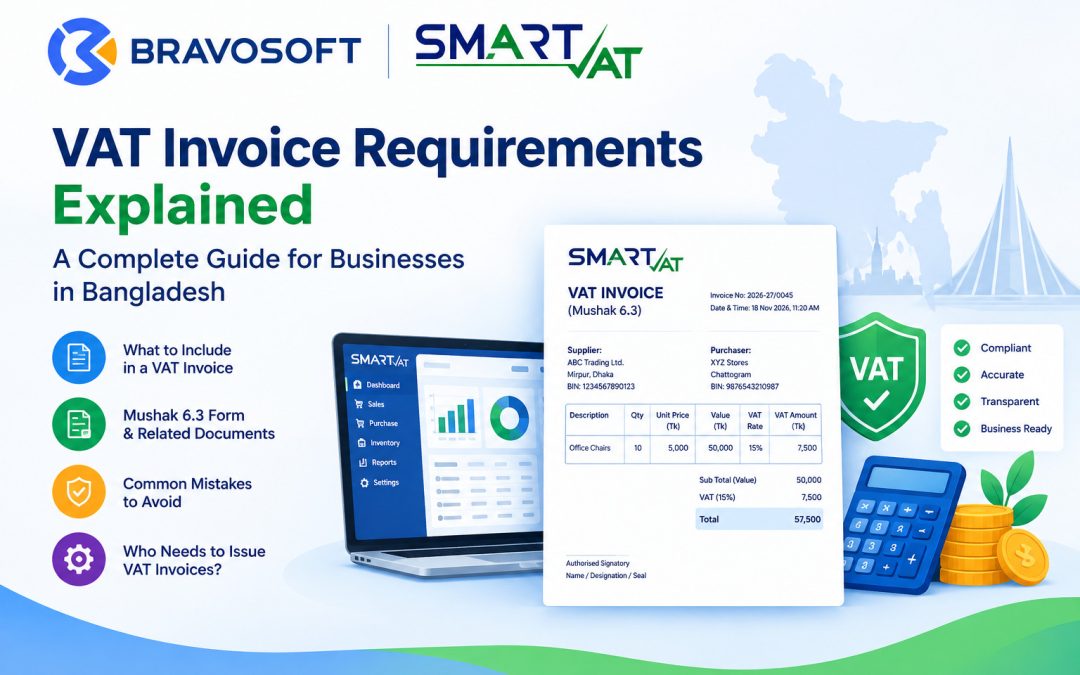
An Illustrative Example
The example below is for explanation only. It is not an official legal template. Use NBR’s published Mushak 6.3 for the actual form.
|
Field |
Illustrative entry |
|---|---|
|
Form |
Mushak 6.3 (VAT-6.3) |
|
Invoice serial |
2026-27/0045 (fiscal-year series) |
|
Date and time |
18 November 2026, 11:20 AM |
|
Supplier |
ABC Trading Ltd., Mirpur, Dhaka, BIN: (13-digit BIN) |
|
Purchaser |
XYZ Stores, Chattogram, BIN: (13-digit BIN) |
|
Item |
Office chairs, 10 units at Tk 5,000 each |
|
Value without VAT |
Tk 50,000 |
|
VAT rate |
15% (illustrative standard rate) |
|
VAT amount |
Tk 7,500 |
|
Total |
Tk 57,500 |
Because the supply exceeds Tk 25,000, the purchaser’s name, address and BIN appear on the invoice. A real invoice would also show transport details and the authorised signatory.
Common Mushak 6.3 Mistakes
- Leaving out the issue time, or using only a date.
- Entering a wrong or incomplete BIN.
- Showing a VAT-inclusive price without separating value and VAT.
- Reusing a serial number or skipping the place-of-supply series.
- Issuing a corrected document without a proper credit or debit note.
Who Needs to Issue VAT Invoices?
The duty in section 51 falls on every registered or enlisted person making a taxable supply. How it plays out varies by business type:
- Manufacturers: issue Mushak 6.3 for each taxable sale. Supplementary duty, where it applies, appears on the same invoice.
- Retailers: many retail categories are among the 27 business types required to use EFD, SDC or PKI POS software and issue VS Challans.
- Wholesalers and traders: issue Mushak 6.3 on taxable sales and should check which Third Schedule trading-stage or wholesale rate applies.
- Importers and distributors: VAT on imports is paid at the import stage, but their later local taxable supplies still need proper invoices. Importers and exporters must register regardless of turnover.
- Service providers: issue Mushak 6.3 for taxable services, at the rate for the specific service.
- Multi-branch businesses: a person with several units may take a single central registration under section 5, keeping accounts and records centrally in automated software. The invoice rules still require a separate serial series for each place of supply.
Whether a supply is taxable, exempt or zero-rated, and which rate applies, depends on the Act’s schedules and current SROs. Confirm each product or service before setting up invoice templates.
Common VAT Invoice Mistakes Businesses Should Avoid
The consequences below are general. Actual outcomes depend on the facts, the amount involved and the officer’s findings.
- Incorrect or missing BIN. A wrong supplier or buyer BIN can leave the invoice defective, which puts the buyer’s credit claim at risk.
- Incomplete invoice details. Missing time, description, rate or place-of-supply information may mean the document fails rule 40(3) as evidence.
- Incorrect VAT calculation. Applying the standard rate where a reduced rate applies, or the reverse, distorts both output tax and customer pricing.
- Duplicate or inconsistent numbering. Serial numbers must run by fiscal year, with separate series for each place of supply. Gaps and duplicates invite questions.
- Incorrect taxable value. Mixing VAT-inclusive and VAT-exclusive prices, or mishandling discounts and supplementary duty, produces wrong VAT amounts.
- Poor recordkeeping. Section 107 requires records to be kept for five years. Lost or scattered invoices make that difficult to prove.
- Mismatch between sales records and VAT returns. Output VAT in the return that cannot be traced to issued invoices is a common review trigger.
- No branch-wise invoice records. Where a business supplies from several places, missing branch-level series and records weaken traceability.
The Act also provides administrative penalties and, for dishonest conduct such as using fake invoices, criminal offences. For example, section 85(1) lists a penalty for failing to issue a tax invoice and for not keeping records as prescribed. Check the current amounts in the consolidated Act or ask a VAT professional, as figures have been amended over time.
VAT Invoice Recordkeeping: Best Practices for Businesses
The legal baseline is simple. Section 107(1) of the Act requires a registered person to keep accounts, documents and records for five years, and longer where a proceeding is pending (section 107(3)). Since 1 July 2026, section 107(2A) allows records to be kept on a secure server through ERP or NBR-specified VAT software, and such records are legally admissible. Beyond that baseline, these practices are recommended accounting discipline rather than separate legal duties:
- Consistent numbering: lock the fiscal-year series and the per-place series in your system so staff cannot overwrite them.
- Proper documentation: attach delivery challans, purchase orders and payment evidence to each invoice.
- Digital storage: keep searchable digital copies with controlled access and backups.
- Invoice reconciliation: compare issued invoices with the sales ledger every month before preparing the return.
- Sales and VAT record matching: reconcile output VAT in the books with the figure in the Mushak 9.1 return.
- Audit-ready files: organise records by period and branch so any invoice can be produced quickly.
- Branch-wise reporting with central monitoring: let each location report its own series while head office reviews consolidated totals.
Note also that, according to NBR’s rules, the purchase and sales books (VAT-6.1 and VAT-6.2) are to be kept in ERP software from 1 July 2025 (rule 40(1)(bbb)). Check whether this applies to your business category.
Quick Checklist: What to Verify Before Issuing a VAT Invoice
- Is the supply taxable, and is the invoice on Form VAT-6.3 (or VAT-6.9 for an enlisted person)?
- Does it show the correct date and time of issue?
- Are the supplier’s name, address and BIN correct?
- If the value exceeds Tk 25,000, are the purchaser’s name, address and BIN included?
- Are the goods or services, quantity and, for goods, transport details described?
- Is the taxable value shown without VAT?
- Is the correct VAT rate (and supplementary duty, if any) applied?
- Is the VAT amount calculated and the total shown?
- Is the serial number unique, in sequence for the fiscal year and in the right place-of-supply series?
- Are at least two copies produced and the record stored?
- If a fiscal device category applies, is the VS Challan generated through approved software?
Manual VAT Invoice Management vs Automated VAT Management
Manual and spreadsheet-based processes can work for a small business with one location. They become harder to control as invoice volume, product variety and branch count grow.
|
Area |
Manual process |
Automated VAT management |
|---|---|---|
|
Invoice preparation |
Typed or copied by staff, format varies |
Generated from system data in a consistent layout |
|
VAT calculation |
Formulas in spreadsheets, easy to break |
Calculated from configured rates and rules |
|
Data accuracy |
Depends on individual care |
Validation checks reduce entry errors, if master data is correct |
|
Recordkeeping |
Paper files and scattered folders |
Centralised digital records with history |
|
Branch-level visibility |
Reports arrive late and in different formats |
Branch data viewed together in one place |
|
Reporting |
Rebuilt by hand each period |
Reports drawn from live transaction data |
|
Reconciliation |
Time-consuming matching of sales, ledger and return |
Easier matching because the data comes from one source |
|
Audit preparation |
Search for documents under time pressure |
Records and audit trail retrieved on demand |
Automation improves the process, but it does not fix bad inputs. Wrong product rates, outdated configuration or inaccurate master data will still produce wrong invoices, so setup and review remain a business responsibility.
How VAT Management Software Helps Businesses Maintain Invoice Accuracy
VAT automation software supports invoice accuracy in several practical ways:
- Centralised invoice management: one place holds invoices from all branches and sales channels.
- Rule-based VAT calculation: the system applies the rates and duties you configure for each item.
- Invoice validation: required fields and numbering rules can be checked before a document is finalised.
- Sales data integration: connecting ERP, accounting or POS systems avoids re-keying and the errors that come with it.
- Multi-branch monitoring: head office sees location-wise VAT positions without waiting for manual reports.
- VAT reporting: returns and supporting reports are prepared from recorded transactions.
- Recordkeeping and audit preparation: a stored history makes it easier to meet the retention rules in section 107.
This fits the direction of the law. Digital record storage through ERP or NBR-specified software is now expressly recognised in section 107(2A), and NBR already requires fiscal-device invoicing for listed retail categories.
How SmartVAT Helps Simplify VAT Management in Bangladesh
SmartVAT is a VAT management platform for businesses in Bangladesh, positioned as NBR-enlisted VAT software and designed around the VAT and Supplementary Duty Act, 2012. It is offered by Bravosoft Limited, and further information is available on the SmartVAT automated VAT management software page.
Based on the product information published by its provider, SmartVAT supports:
- Automated VAT calculation on sales and purchase transactions, with support for multiple VAT rates and supplementary duties.
- Input and output tax matching, so net VAT payable can be tracked and reconciled.
- Mushak form generation, including returns such as Mushak 9.1, 9.2 and 4.3, prepared from transaction data.
- Real-time VAT reporting from a dashboard covering sales, purchases, input and output tax and transaction history.
- ERP, accounting and POS integration through open API, so VAT data stays in sync with existing systems.
- Audit trail and compliance records for transactions, calculations and filings.
- Multi-branch support, consolidating VAT data across locations with combined or location-specific reports.
- Data migration from a previous system when a business switches.
For businesses already running an ERP, the value is practical: sales data flows into one VAT system, the figures behind the return can be traced, and branch positions are visible together. You can read more on the About SmartVAT page or see the SmartVAT blog for other VAT guides. As with any software, results depend on correct configuration and clean source data, and invoice formats for your category should be confirmed against current NBR requirements during setup.
Frequently Asked Questions
What are the VAT invoice requirements in Bangladesh?
A registered person must issue a tax invoice on Form VAT-6.3 on or before the date tax becomes payable (section 51). Under rule 40(1)(c), it shows date and time, supplier name, address and BIN, goods description, value, VAT rate, VAT amount, total and a fiscal-year serial number, with purchaser details where required.
What is a Mushak 6.3 VAT invoice?
Mushak 6.3 is the prescribed tax invoice form under rule 40 of the VAT and Supplementary Duty Rules, 2016. A VAT-registered business issues it for each taxable supply. It records the taxable value, VAT rate and VAT amount, and it supports the buyer’s input credit claim and the seller’s output VAT reporting.
Is BIN mandatory on a VAT invoice?
The supplier’s name, address and BIN are required on every Mushak 6.3 invoice. The purchaser’s BIN is required where applicable, which under the current clause means supplies exceeding Tk 25,000. Enlisted turnover tax payers also hold a BIN. Always confirm the current rule text before relying on a threshold.
What information must be included in a VAT invoice?
The invoice must show the form name, date and time of issue, supplier details, purchaser details where applicable, a description of the goods or services, taxable value, VAT rate, VAT amount, total, and a serial number by fiscal year. Multi-location suppliers need a separate series for each place of supply.
Who is required to issue a VAT invoice?
Section 51 places the duty on every registered or enlisted person making a taxable supply. Registered persons use Mushak 6.3, while enlisted turnover tax payers use Form VAT-6.9. Which supplies are taxable, exempt or zero-rated depends on the Act’s schedules and current SROs, so check each product or service.
Can a business issue VAT invoices digitally?
Yes, in many cases. Rule 40(2) lets a registered person keep the form in its own format if the name, prescribed particulars and copy count are kept, and section 107(2A) allows electronic records. For 27 listed business categories, NBR requires VS Challans from approved EFD, SDC or PKI POS software.
How long should VAT invoices and related records be maintained?
Section 107(1) of the VAT and Supplementary Duty Act, 2012 requires a registered person to keep accounts, documents and records for five years. If a proceeding is pending, records linked to it must be kept until it ends, even beyond five years (section 107(3)).
What happens if a VAT invoice contains incorrect information?
Under rule 40(3), a defective or incomplete invoice is not valid evidence for input credit or an adjustment. Corrections are made through a credit note (VAT-6.7) or debit note (VAT-6.8) rather than overwriting the invoice. Administrative penalties may apply depending on the facts, so consult a VAT professional.