
Author

Every VAT-registered business in Bangladesh collects tax on behalf of the government, and each taka has to be traced from invoice to return. This guide gives you VAT compliance explained for businesses in practical terms: the duties involved, how the Mushak forms fit together, and where growing companies usually slip.
The rules moved on 1 July 2026, when the Finance Act 2026 took effect. Time-sensitive points below carry a date and a source. This is educational content, not legal or tax advice.
What Is VAT Compliance?
VAT compliance is the process of registering with the tax authority, charging and recording VAT correctly, issuing valid invoices, reconciling input and output VAT, filing returns, paying VAT due and keeping records that can be verified. In Bangladesh, these duties come from the VAT and Supplementary Duty Act, 2012 and are administered by the National Board of Revenue (NBR).
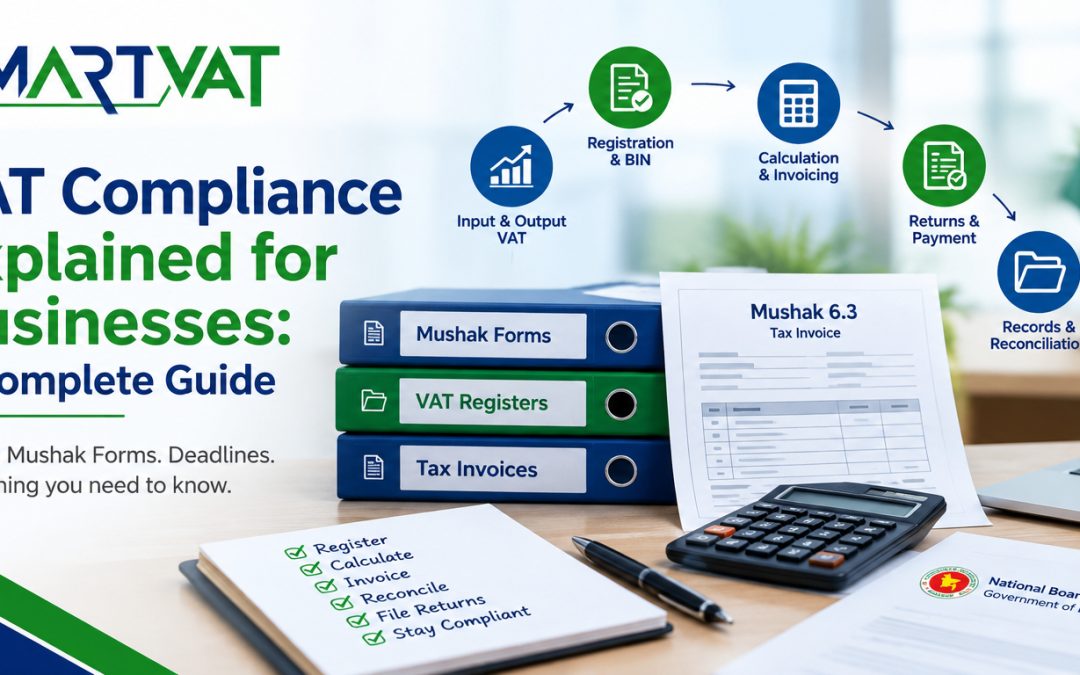
In practice, compliance has three layers. Registration gives the business a Business Identification Number (BIN). Transaction discipline covers calculation, invoicing and record keeping. Reporting covers reconciliation, return filing and payment. A gap in any layer shows up later as a mismatch, a lost input credit or an audit query. Mushak is NBR’s term for its prescribed VAT forms. The legal text is the VAT and Supplementary Duty Act, 2012.
Why Is VAT Compliance Important for Businesses?
Good VAT compliance is less about avoiding trouble than about running a cleaner business:
- Accurate tax reporting. The return reflects what was actually sold and bought.
- Better financial records. One set of accounts serves both finance and VAT, as NBR’s VAT FAQ describes.
- Fewer calculation errors. Rates and rounding are applied the same way every time.
- Easier reconciliation. Clean data is quicker to match against the return.
- Easier return preparation. Figures come from registers, not last-minute rebuilding.
- Audit readiness. After an audit notice, documents are due within two months.
- Lower administrative workload. Less rework and fewer late corrections.
- Visibility into VAT liabilities. Finance teams see the likely net payable before it falls due.
The cost of falling short is concrete. The Act provides for interest on unpaid VAT and penalties for offences, and an input credit can be refused when the supporting tax invoice is missing or invalid.
Who Needs to Comply With VAT Requirements?
Businesses that make taxable supplies in Bangladesh, import or export goods, or exceed NBR’s turnover limit must register for VAT, or enlist for turnover tax if smaller, and follow the full compliance cycle. Businesses dealing only in First Schedule exempt goods and services are generally not required to register.
- Registration versus enlistment. Registered VAT payers file Mushak 9.1 (manufacturers and service providers) or 9.1.1 (traders). Enlisted turnover-tax payers file Mushak 9.2.
- A BIN reaches beyond tax. From 1 July 2026, a BIN or enlistment proof is required to open a business bank account, take a bank loan, renew a trade licence or register a business vehicle, among other uses.
- Thresholds change. Turnover limits have been revised in recent years, and NBR’s own VAT FAQ still shows earlier figures, so this article quotes none. Confirm the current limit with NBR.
For application steps, read SmartVAT’s guide to VAT registration in Bangladesh. For the law in business terms, see the VAT Act 2012 guide.
Key Components of VAT Compliance
Nine components make up the compliance cycle.
VAT Registration and BIN
Registration gives the business a BIN, the number on every VAT document. Applications go through NBR’s eVAT system at vat.gov.bd. Under the 2026 rules, a valid application produces the certificate (Mushak 2.3) with the BIN by email at once, and NBR verifies afterwards. One registration can generally cover all branches of a company. Report changes within 15 days.
Correct VAT Calculation
The standard rate is 15%. Exports are zero-rated, First Schedule items are exempt, and some items carry reduced or fixed amounts. When a price includes VAT, NBR’s method is price multiplied by 15/115: a Tk 1,500 sale price contains Tk 195.65 of VAT. Configure the right rate per item and review it whenever NBR issues an SRO.
VAT Invoicing
A tax invoice (Mushak 6.3) is issued for each taxable supply. It shows the buyer’s name, invoice number, seller’s BIN, buyer’s BIN where applicable, description, quantity, value and VAT. Related documents include Mushak 6.4 to 6.8 (contractual production, transfers, VDS certificate, credit and debit notes). NBR’s 2026-27 VAT Instruction recognises electronic tax invoices.
Input VAT and Output VAT
Output VAT is charged on sales; input VAT is paid on purchases. NBR sets net tax as output tax plus increasing adjustments, minus input tax and decreasing adjustments. Credit generally needs a valid Mushak 6.3 and banking-channel payment for supplies above Tk 100,000.
VAT Record Keeping
Registered persons keep a purchase register (Mushak 6.1), a sales register (6.2, 6.2.1), invoices, notes, certificates and returns for five years. Digital records are accepted, and a 2026 amendment to section 107 makes records kept through ERP or NBR-prescribed VAT software legally admissible.
VAT Return Filing
Returns are filed online through eVAT on Mushak 9.1 (manufacturers and service providers), 9.1.1 (traders) or 9.2 (turnover tax). Frequency changed in 2026.
Position as of 20 September 2026. Under section 64 as substituted by the Finance Act 2026, in force from 1 July 2026, a return is due within 15 days after the end of every three tax periods (a tax period is one calendar month). Government bodies, banks, insurers and nil-return filers get 20 days. Voluntary monthly filing is allowed. NBR’s VAT Instruction for 2026-27 also describes an interim deposit of one-third of the preceding three periods’ tax within 15 days after each period.
This area is moving. The Daily Star reported in September 2026 that NBR has asked the finance ministry to restore monthly returns and payments. Follow the notified rules and check NBR notices before each deadline.
VAT Payment
Net VAT is deposited through NBR’s e-payment or challan channels before the return is submitted, and partial payment is not tenable at filing. Interest applies after the due date. A withholding entity deposits VAT deducted at source and issues a Mushak 6.6 certificate, which the supplier uses as an adjustment.
VAT Reconciliation
Reconciliation matches registers, tax invoices, challans and ledger balances against the return before filing. Check that every Mushak 6.3 issued is in the sales register, every credit claimed has a valid purchase invoice, and VDS certificates match adjustments. Reconcile monthly even if you file quarterly, because errors compound.
Audit-Ready Documentation
After an audit notice, documents are due within two months (extendable by one month) and the audit is to finish within a year; without documents, the authority may use best judgment assessment. Audit-ready means every return figure traces quickly to an invoice, a payment record and a register entry.
Input VAT vs Output VAT
Input VAT is the VAT a business pays on its purchases and imports. Output VAT is the VAT it charges customers on taxable sales. A business generally deposits the difference: output VAT plus any increasing adjustments, less eligible input VAT and decreasing adjustments, as set out in NBR’s VAT guidance.
| Aspect | Input VAT | Output VAT |
|---|---|---|
| Meaning | VAT paid on purchases and imports used in the business | VAT charged to customers on taxable sales |
| Usually arises from | Supplier tax invoices (Mushak 6.3) and bills of entry for imports | Your own tax invoices for taxable goods and services |
| Business relevance | Reduces net VAT payable when credit conditions are met | Forms the VAT collected for the government and increases net payable |
At 15%, goods bought for Tk 10,000 carry Tk 1,500 input VAT and goods sold for Tk 15,000 carry Tk 2,250 output VAT, so net VAT payable is Tk 750 before adjustments.
VAT Compliance Explained for Businesses: The Step-by-Step Process
- Determine applicable VAT obligations. Check whether you must register, enlist or are exempt.
- Complete registration or enlistment. Apply through eVAT and obtain your BIN.
- Maintain accurate transaction records. Enter every sale and purchase in the registers.
- Calculate VAT correctly. Apply the right rate, base and supplementary duty.
- Issue required VAT documents. Tax invoices, notes and VDS certificates.
- Track input and output VAT. Keep credits and adjustments visible.
- Reconcile VAT data. Match registers, invoices, ledgers and payments.
- Prepare required returns. Use Mushak 9.1, 9.1.1 or 9.2.
- Submit returns and pay. Follow the schedule in force.
- Maintain supporting records. Archive documents for five years.
The forms you will meet along the way:
| Mushak form | Purpose |
|---|---|
| 2.1, 2.3 | Registration application and certificate with BIN |
| 4.3, 4.3.1 | Input-output coefficient declarations |
| 6.1, 6.2, 6.2.1 | Purchase, sales and combined registers |
| 6.3 | Tax invoice |
| 6.6 | VDS certificate |
| 6.7, 6.8 | Credit and debit notes |
| 9.1, 9.1.1 | VAT returns (manufacturers and service providers; traders) |
| 9.2 | Turnover tax return |
Common VAT Compliance Mistakes Businesses Make
Most errors are process failures, not knowledge gaps:
- Incorrect calculations. Wrong base or rounding causes over- or underpayment.
- Outdated VAT rates. Budgets and SROs change rates and exemptions.
- Incomplete documents. A tax invoice without correct BIN details can put the buyer’s credit at risk.
- Poor record keeping. Missing registers or invoices weaken your audit position.
- Input and output mismatches. Credit claimed without a matching supplier invoice invites queries.
- Spreadsheet errors. Overwritten formulas and version confusion.
- Incomplete transaction data. Branch or POS sales that never reach the VAT record.
- Delayed reconciliation. Discrepancies found only at filing time.
- Incorrect return information. Wrong form, period or figures.
- Missing supporting documents. Challans, VDS certificates and payment evidence.
- Inconsistent data. Accounting, ERP, POS and VAT records that disagree.
The practical consequences are interest, disallowed credits, penalties and longer audits.
VAT Compliance Checklist for Businesses
☐ VAT registration/BIN information is current
☐ Applicable VAT rates are correctly configured
☐ Sales transactions are recorded accurately
☐ Purchase transactions are recorded accurately
☐ VAT invoices are properly maintained
☐ Input VAT is tracked
☐ Output VAT is tracked
☐ VAT data is reconciled
☐ Required returns are prepared correctly
☐ Supporting records are archived
☐ Filing/payment obligations are monitored
☐ VAT reports are ready for review or audit
Manual VAT Compliance vs Automated VAT Management
| Task | Manual (spreadsheets) | Automated (VAT software) |
|---|---|---|
| VAT calculation | Formulas maintained by hand | Rates set once, applied per transaction |
| Transaction data | Separate files per branch | Centralised, often fed from ERP, accounting or POS |
| Input and output VAT | Separate sheets matched by hand | Tracked together with matching support |
| Reconciliation | Periodic, line by line | Ongoing checks against registers and ledgers |
| Reporting | Rebuilt for each return | Generated from stored data |
| Records | Hard-to-search folders | Digital archive with audit trail |
Manual processes can work at low volume. Strain appears with more branches, invoices and rate changes. Automation reduces repetitive errors, but it does not remove compliance risk: wrong master data, wrong tax treatment or missing documents still produce wrong returns.
How VAT Software Can Support VAT Compliance
VAT software typically supports the routine work in this guide:
- VAT calculation on sales and purchases
- VAT reporting and liability views
- Input and output VAT tracking
- Reconciliation support
- Mushak reporting and return preparation
- An audit trail of transactions and filings
- Multi-branch VAT management
- ERP, accounting and POS integration
The regulatory context favours digital records. A 2026 amendment to section 107 accepts records held through ERP or NBR-prescribed software as legal evidence. PwC’s Bangladesh tax summary also reports that businesses above a prior-year sales threshold must use NBR-approved software, so confirm whether that applies to you. One example is SmartVAT VAT management software, which describes calculation, Mushak forms and reporting in one platform. Related reading: VAT automation software and how automated VAT filing works.
Software supports VAT management and compliance workflows. It does not replace professional tax judgment or the business’s responsibility for accurate data.
How SmartVAT Supports Business VAT Management
SmartVAT is a web-based VAT management platform, and its website appears on NBR’s list of enlisted software firms. Its software page lists Mushak 4.3, the 6.x registers and invoices, and Mushak 9.1 and 9.2, plus data import and export, API integration with ERP systems, and cloud, on-premises or hybrid deployment. The product page linked above adds deadline reminders, multi-branch support and data migration. Test any tool on your own data, branches and rules.
Frequently Asked Questions
What is VAT compliance?
VAT compliance means meeting every legal duty attached to VAT: registering, charging the right rate, issuing valid tax invoices, keeping registers, reconciling input and output VAT, filing returns and paying what is due. In Bangladesh these duties follow the VAT and Supplementary Duty Act, 2012 and NBR rules.
Why is VAT compliance important for businesses?
It keeps returns accurate, protects input credits, reduces interest and penalty exposure and makes audits less disruptive. It also gives management a clear view of VAT liabilities and cleaner records, because sales, purchases and VAT figures come from the same verified data.
What are the main VAT compliance requirements?
The main requirements are registration or enlistment with a BIN, correct rates, Mushak 6.3 tax invoices, statutory registers kept for five years, input and output VAT tracking, return filing on the correct Mushak form, payment of net VAT, and audit readiness.
What is a BIN in Bangladesh?
A Business Identification Number (BIN) is the unique number NBR issues to a registered or enlisted business. It appears on tax invoices and returns. The certificate (Mushak 2.3) is issued through the eVAT system, and a BIN is now also required for several banking and licensing tasks.
What is the difference between input VAT and output VAT?
Input VAT is VAT paid on purchases and imports. Output VAT is VAT charged on taxable sales. The business deposits output VAT plus increasing adjustments, less eligible input VAT and decreasing adjustments. Credit generally requires a valid Mushak 6.3 tax invoice.
What records should a business maintain for VAT compliance?
Keep the purchase register (Mushak 6.1), sales registers (6.2, 6.2.1), tax invoices (6.3), other invoices and notes (6.4 to 6.8), returns and supporting payment evidence. NBR’s VAT FAQ says to preserve all of them for five years, and digital records are accepted.
How often do businesses need to file VAT returns?
As of 20 September 2026, the Finance Act 2026 requires a return within 15 days after every three tax periods (quarterly), with 20 days for government bodies, banks, insurers and nil-return filers. Monthly filing is optional. NBR is reportedly reviewing a return to monthly filing, so check its notices.
What are common VAT compliance mistakes?
Common mistakes include wrong or outdated rates, incomplete tax invoices, mismatched input and output VAT, spreadsheet errors, missing documents, late reconciliation and inconsistent data across accounting, ERP, POS and VAT systems. Most are process failures that regular reconciliation catches early.
How can businesses improve VAT compliance?
Set rates centrally, issue every tax invoice from a controlled system, reconcile monthly even when returns are quarterly, keep documents in one searchable archive, assign clear ownership for filing and payment, and review NBR notices after each budget. Automating repetitive steps also reduces manual errors.
Can VAT software help with compliance?
Yes. VAT software can calculate VAT, track input and output VAT, prepare Mushak reports and returns, keep an audit trail and connect with ERP, accounting or POS systems. It cannot fix inaccurate source data or replace professional judgment, so results still need review.
What is VAT reconciliation?
VAT reconciliation is the process of matching sales and purchase registers, tax invoices, payment challans and ledger balances against the return before filing. It confirms that every credit claimed has support and that reported output VAT ties to the books.
Is VAT software a replacement for professional tax advice?
No. Software supports calculation, reporting and record keeping, but it does not decide how a transaction is treated under the law. Businesses remain responsible for accurate data and should seek advice from a qualified VAT consultant, chartered accountant or NBR when a position is unclear.