
Author

What Is VAT Automation Software? Explained
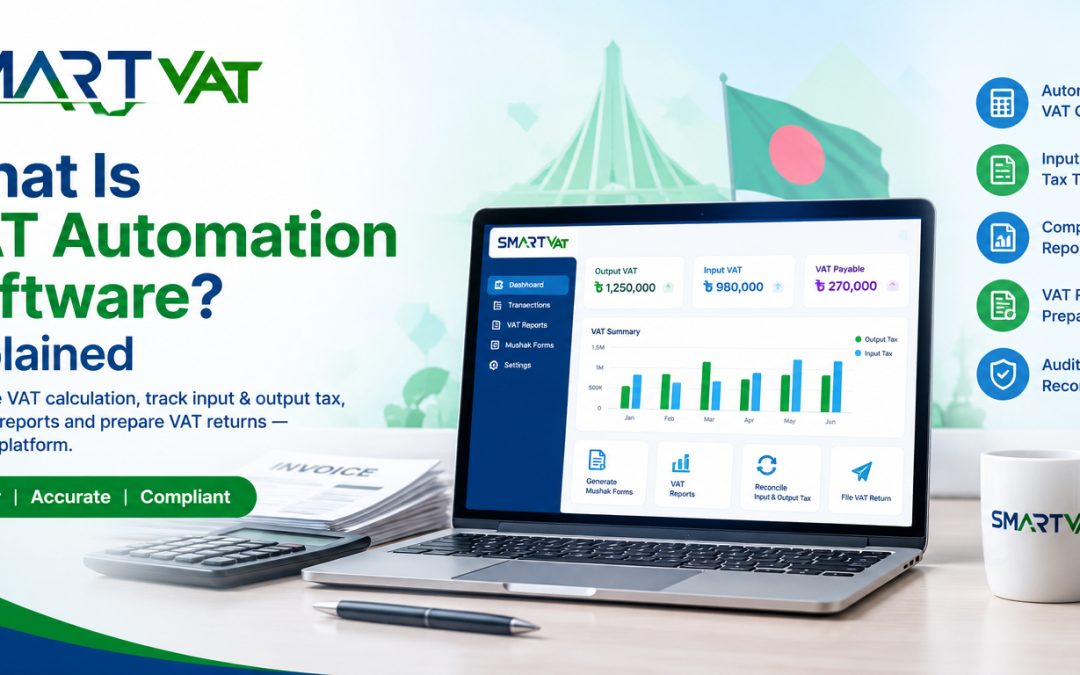
VAT automation software is a digital system that calculates VAT, tracks input and output tax, generates compliance reports, and prepares VAT returns automatically, instead of businesses relying on spreadsheets and manual data entry. For companies in Bangladesh, this means fewer calculation errors, faster reporting, and a more organized approach to VAT compliance under the VAT and Supplementary Duty Act, 2012. This guide explains what VAT automation software is, how it works, what it automates, and how businesses can evaluate the right solution, including examples such as SmartVAT.
What Is VAT Automation Software?
VAT automation software is a tool that automates the calculation, tracking, reconciliation and reporting of Value Added Tax on business transactions. Rather than staff manually calculating VAT on every invoice and compiling reports at month end, the software applies VAT rules to sales and purchase data as transactions happen.
At its core, VAT is a consumption tax charged on the value added to goods and services at each stage of production or distribution. Businesses that are VAT registered must calculate the VAT they charge on sales (output tax), track the VAT they pay on purchases (input tax), and report the difference to the tax authority. VAT automation software is built to handle this process consistently, so businesses spend less time on manual calculation and more time reviewing accurate results.
How Does VAT Automation Software Work?
VAT automation software generally follows a consistent workflow, even though the exact features vary between products:
- Data capture: Sales and purchase data is pulled in from invoices, point of sale systems, accounting software or an ERP, either through integration or direct entry.
- Rule application: The software applies the applicable VAT rates and rules to each transaction automatically.
- Input and output tax tracking: VAT paid on purchases and VAT charged on sales are recorded separately and matched against each other.
- Reconciliation: The system checks that transaction records, tax amounts and supporting documents are consistent.
- Reporting and filing preparation: The software generates VAT reports and prepares the forms needed for a VAT return, ready for review and submission.
- Record keeping: Every transaction and calculation is stored digitally, creating an audit trail businesses can refer back to.
What Does VAT Automation Software Automate?
Depending on the platform, VAT automation software can handle:
- VAT calculation on sales and purchase transactions
- Input tax and output tax management
- VAT reconciliation between transaction records and tax due
- VAT reporting, including summaries by period, branch or product line
- VAT return preparation and generation of required forms
- Compliance record keeping for filed returns and supporting documents
- Data validation to catch missing or inconsistent entries
- Filing workflow support, such as tracking deadlines
- Audit trails that log every transaction and calculation
Key Features of VAT Automation Software
Most VAT automation platforms are built around a similar set of core capabilities. You can see many of these features illustrated in this VAT management solution by Bravosoft, which packages calculation, reporting and filing support into one platform.
- Automated VAT calculation on every transaction
- Real-time or on-demand VAT reporting
- Integration with ERP, accounting or POS systems
- Automatic generation of VAT return forms
- Digital audit trail for transactions and filings
- Support for multiple branches or business locations
- Data import and export tools
- Cloud, on-premises or hybrid deployment options
Benefits of VAT Automation Software
Businesses that move from manual VAT processes to automation typically see benefits such as:
- Reduced manual work: Staff spend less time on repetitive data entry and calculation.
- Fewer calculation errors: Automated rules reduce the risk of manual formula mistakes.
- Faster reporting: VAT reports can be generated in minutes rather than days.
- Better visibility: Finance teams can see VAT liability and transaction history at any time.
- Improved compliance workflow: Structured reporting makes it easier to keep up with filing requirements.
- Easier reconciliation: Input and output tax matching happens automatically rather than manually.
- Better record keeping: Digital records and audit trails are easier to retrieve than paper files.
- Integration with existing systems: VAT data can stay in sync with ERP, accounting or POS platforms already in use.
These are process improvements rather than guarantees. VAT automation software supports compliance and accuracy, but it does not replace the need for correct data entry, an understanding of applicable VAT rules, or periodic review by a qualified professional.
Manual VAT Management vs VAT Automation Software
| Aspect | Manual VAT Management | VAT Automation Software |
| Data entry | Manual entry from invoices and receipts | Captured automatically from POS, ERP or accounting systems |
| VAT calculations | Calculated by hand or in spreadsheets | Calculated automatically on every transaction |
| Reporting | Compiled manually, often at month end | Generated in real time or on demand |
| Reconciliation | Input and output tax matched manually | Input and output tax matched automatically |
| Error risk | Higher, due to manual formulas and re-keying | Lower, since calculations follow fixed rules |
| Record keeping | Paper files or scattered spreadsheets | Centralized digital records with audit trails |
| Compliance workflow | Depends on staff tracking deadlines | Supported by structured reporting and reminders |
| Scalability | Becomes harder as transaction volume grows | Handles higher transaction volumes without added manual effort |
Who Needs VAT Automation Software?
VAT automation software is useful for any VAT-registered business, but it tends to deliver the most value for:
- High transaction volume businesses, such as FMCG companies and retailers, where manual calculation becomes time-consuming.
- Manufacturing and industrial businesses, including furniture, chemical and pharmaceutical companies, that manage input tax across raw materials and production stages.
- Oil, gas and energy businesses with complex, multi-stage transactions.
- Hotels, restaurants and service businesses that process a high number of daily sales transactions.
- SMEs and large enterprises that currently manage VAT through spreadsheets or manual processes and want fewer errors and faster reporting.
- Businesses operating across multiple branches that need consolidated VAT reporting.
VAT Automation Software in Bangladesh
In Bangladesh, VAT is administered by the National Board of Revenue (NBR) under the Value Added Tax and Supplementary Duty Act, 2012. VAT registration, return filing and related services are increasingly handled through the government’s VAT Online portal, and VAT-registered businesses use standardized Mushak forms for purchase and sales records, invoices, credit and debit notes, and VAT returns.
Because VAT rules, rates and filing requirements can change, businesses should always confirm current requirements directly through NBR’s VAT publications or a qualified tax professional rather than relying solely on third-party summaries, including this article.
VAT automation software used in Bangladesh is often built specifically to generate Mushak forms and align with NBR’s reporting formats. Some software providers are also enlisted with NBR, which businesses can verify through NBR’s enlisted VAT software list.
How SmartVAT Helps Businesses Automate VAT Operations
SmartVAT is a VAT management software built for businesses in Bangladesh. According to SmartVAT’s VAT management software page, SmartVAT is enlisted by the National Board of Revenue and is designed to operate in compliance with the VAT and Supplementary Duty Act, 2012.
SmartVAT’s stated capabilities include:
- Real-time VAT operation management with reporting that follows NBR rules
- Generation of Mushak forms, including Mushak 4.3 (Input-Output Coefficient Declaration), Mushak 6.1 to 6.10 (purchase and sales account books, invoices, credit and debit notes), and Mushak 9.1 and 9.2 (VAT and turnover tax returns)
- Integration with third-party ERP and accounting systems, including API-based integration
- A user-friendly, web-based interface with a simple dashboard
- Support for cloud, on-premises and hybrid deployment models
SmartVAT is used across industries including FMCG, furniture, chemical, pharmaceutical, oil and gas, and hotels and restaurants. Businesses can review the team behind SmartVAT or read more on SmartVAT’s blog before deciding whether the platform fits their VAT operation.
How to Choose the Right VAT Automation Software
Before selecting a VAT automation platform, it helps to evaluate:
- Regulatory compliance: Does the software align with current VAT rules and, where applicable, NBR enlistment?
- Automation capabilities: Which VAT tasks does it actually automate, and which still require manual input?
- Integration: Can it connect with your existing ERP, accounting or POS system without disrupting current workflows?
- Reporting: Does it produce the reports and return formats your business needs?
- Security: How is transaction and financial data protected?
- Scalability: Can it handle growth in transaction volume, branches or product lines?
- Ease of use: Can your finance team use it without extensive retraining?
- Support: What level of implementation and ongoing support is available?
- Customization: Can the software be configured to your specific VAT workflows?
- Data migration: How will existing VAT records be transferred into the new system?
- Total cost of ownership: What are the full costs, including setup, integration and ongoing use?
Final Thoughts
VAT automation software replaces manual, spreadsheet-driven VAT work with automated calculation, reconciliation and reporting. For businesses in Bangladesh, that means less time spent on repetitive tasks and a more organized, auditable approach to VAT compliance under NBR requirements.
If your business is still managing VAT manually, it may be worth reviewing a platform such as SmartVAT. You can get in touch with the SmartVAT team or request a free demo to see how VAT automation could fit your business.
Editorial note: VAT rules and reporting requirements in Bangladesh can change. Businesses should verify current requirements directly with the National Board of Revenue or a qualified tax professional before making compliance decisions.
Frequently Asked Questions About VAT Automation Software
What is VAT automation software?
VAT automation software is a digital tool that automatically calculates VAT, tracks input and output tax, and helps generate VAT reports and returns, reducing the need for manual spreadsheets.
How does VAT automation software work?
It captures transaction data from sources like invoices, POS or ERP systems, applies VAT rules automatically, reconciles input and output tax, and prepares reports and return forms.
What does VAT automation software automate?
It typically automates VAT calculation, input and output tax tracking, reconciliation, reporting, VAT return preparation, data validation and audit trail record keeping.
What are the benefits of VAT automation?
Benefits include less manual work, fewer calculation errors, faster reporting, better visibility into VAT liability, easier reconciliation and improved record keeping.
Is VAT automation software useful for small businesses?
Yes. Small businesses that currently rely on spreadsheets can benefit from automated VAT calculation and reporting, particularly as transaction volume grows.
Can VAT software integrate with ERP systems?
Many VAT automation platforms offer integration with ERP, accounting and POS systems through APIs, so VAT data stays synchronized with other business records.
How does VAT automation help with compliance?
It supports compliance by applying VAT rules consistently, keeping organized digital records, generating standardized reports, and maintaining an audit trail. It does not replace the need to follow current NBR requirements.
What is the difference between VAT software and accounting software?
Accounting software manages a business’s overall financial records, while VAT software focuses specifically on VAT calculation, reconciliation, reporting and return preparation. Many businesses use the two together through integration.
How can businesses choose the right VAT automation software?
Evaluate the software against regulatory compliance, automation capabilities, integration options, reporting, security, scalability, ease of use, support, customization, data migration support and total cost of ownership.
Is SmartVAT suitable for businesses in Bangladesh?
SmartVAT is a VAT management software built for businesses in Bangladesh and enlisted by the National Board of Revenue, according to the SmartVAT website. Businesses should review its features and, where relevant, request a demo to confirm fit for their own VAT workflow.