
Author

Most VAT problems do not start on filing day. They start weeks earlier, when an invoice is missing, a purchase is coded to the wrong rate, or the sales ledger and the accounts no longer agree. By the time the return is due, finance teams are left reconciling numbers under pressure.
This guide gives you the VAT return filing process explained in practical terms, with a focus on Bangladesh. You will learn what a VAT return is, what to gather before you start, how to calculate VAT payable, the ten steps from records to submission, the mistakes to avoid, and a checklist for review. Because Bangladesh changed its return frequency during 2026, we also explain the current position and how to confirm it.
This article is general educational guidance and not professional tax or legal advice. Rules reflected here are as of 14 October 2026 and can change. Confirm current requirements with the National Board of Revenue (NBR) or a qualified adviser.
What Is a VAT Return?
A VAT return is a periodic declaration that a VAT-registered business submits to the tax authority. It summarises the VAT charged on sales (output VAT), the VAT paid on eligible purchases (input VAT), any adjustments, and the net amount payable or carried forward.
In Bangladesh, the VAT return is filed on Form Mushak 9.1 under the Value Added Tax and Supplementary Duty Act, 2012. Businesses enlisted for turnover tax file Mushak 9.2 instead. According to PwC’s Bangladesh tax summary, the standard VAT rate is 15% for most goods and services, though specific rates, exemptions and supplementary duty can apply to particular transactions.
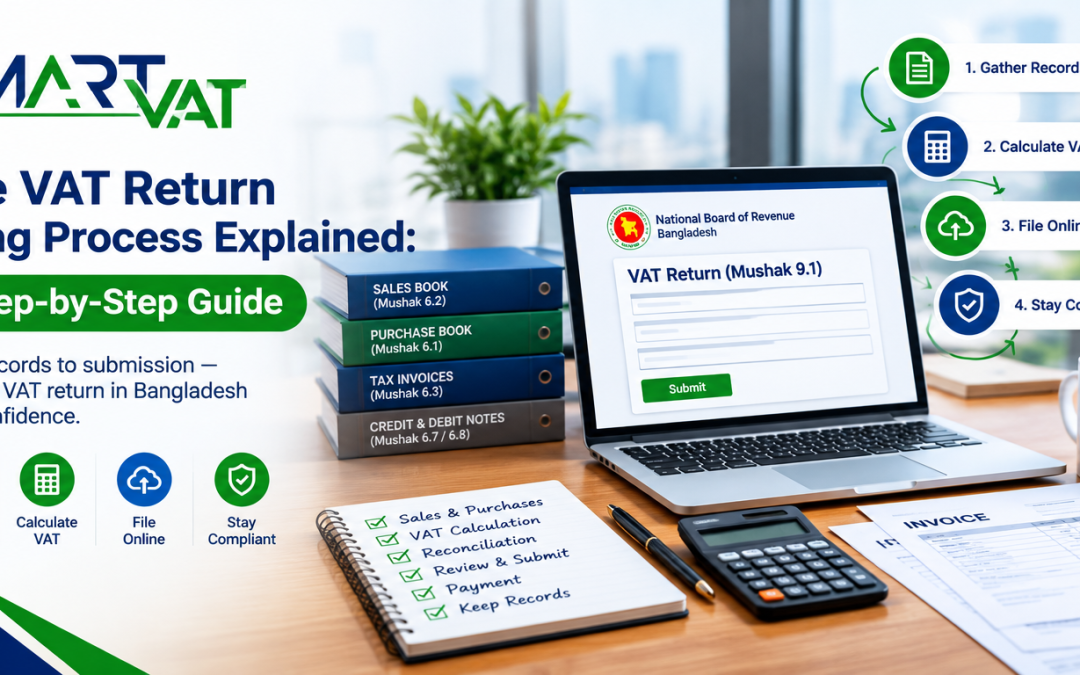
The return is built from your books, not the other way round. In Bangladesh, those books include the purchase account book (Mushak 6.1), the sales account book (Mushak 6.2), tax invoices (Mushak 6.3), and credit and debit notes (Mushak 6.7 and 6.8). If these are incomplete, the return will be too.
Why Is VAT Return Filing Important for Businesses?
Filing accurately matters for four practical reasons:
- Compliance: A registered business is expected to report its VAT position for each period, including periods with no activity. Check current rules on nil returns.
- Accurate financial records: A well-prepared return forces sales, purchases and VAT balances to agree with the accounts.
- Audit readiness: Clean supporting documents make it easier to respond to questions from the VAT authorities.
- Access to refunds and credits: NBR has stated that all VAT returns must be available in the online system before refund applications can be processed, according to a BSS report on the e-VAT transition.
Penalties and interest for late or incorrect returns are set out in the VAT Act and its rules. We do not quote amounts here because they depend on the specific default and current law.
What Information Do You Need Before Filing a VAT Return?
The documents required vary by business type, transaction type and the applicable VAT requirements. As a general baseline, gather:
- Sales invoices and sales records for the tax period
- Purchase invoices and records supporting eligible input VAT
- VAT payment records, such as treasury challans, and VAT deducted at source (VDS) certificates where applicable
- Credit notes, debit notes and other adjustments
- The applicable VAT rate and classification for each product or service
- Previous return records, closing balances and reconciliation reports
- Any other document required under the rules for your activity
The VAT Return Filing Process Explained Step by Step
The steps below apply to most registered businesses. Always check the current NBR instructions for forms, fields and portal procedures before you file.
Step 1: Gather and organise your records
What to do: Collect all sales, purchase, payment and adjustment records for the full tax period in one place. Why it matters: The return can only be as complete as the records behind it. Avoid: Starting late and relying on records scattered across email, paper files and individual spreadsheets.
Step 2: Verify sales, purchases and supporting invoices
What to do: Check that every invoice is valid, complete and recorded in the right period. Why it matters: Errors in source data flow straight into the return. Avoid: Missing invoice numbers, duplicate entries and invoices recorded in the wrong period.
Step 3: Identify the VAT treatment and rate for each transaction
What to do: Confirm whether each transaction is standard rated, reduced rated, exempt, zero rated or subject to supplementary duty or VDS. Why it matters: The wrong classification changes both VAT payable and the input credit you can claim. Avoid: Applying one rate to everything because it is the common one.
Step 4: Calculate output VAT and eligible input VAT
What to do: Total the VAT charged on sales, then total the VAT on purchases that qualify for credit under the rules. Why it matters: The difference drives the amount payable or carried forward. Avoid: Claiming input VAT without a valid supporting invoice or on purchases that are not eligible.
Step 5: Reconcile against accounting records and payments
What to do: Compare VAT totals with the general ledger, bank payments and your sales and purchase books. Why it matters: Reconciliation catches omissions and mismatches before the authority does. Avoid: Treating a mismatch as a rounding issue without investigating it.
Step 6: Review adjustments, exemptions and special treatments
What to do: Apply credit notes, debit notes, VDS, exempt supplies, opening balances and any carried-forward amounts. Why it matters: Adjustments are a common source of misstated returns. Avoid: Posting an adjustment in the wrong period or forgetting it entirely.
Step 7: Complete the VAT return using the official procedure
What to do: Fill in the Mushak 9.1 return using the figures prepared in the previous steps, following the current NBR procedure. NBR has made online filing mandatory from July 2026, with manual returns dispensed with, according to PwC. Why it matters: The return must follow the prescribed structure. Avoid: Re-keying figures by hand when an export or integration can reduce typing errors.
Step 8: Review the return and submit it through the authorised channel
What to do: Have a second person review totals against your working papers, then submit through the NBR’s online VAT system. Why it matters: A second review catches simple errors that the preparer no longer sees. Avoid: Leaving submission to the last day, when portals can be busy.
Step 9: Pay any VAT due within the deadline
What to do: Pay the net VAT through the authorised payment channel and keep the payment evidence. Check whether payment must be completed before the return can be submitted in your case. Why it matters: Filing and payment obligations are linked, and late payment can carry interest. Avoid: Assuming filing alone settles the liability.
Step 10: Retain the return, payment evidence and supporting documents
What to do: Store the submitted return, submission confirmation, payment proof and source documents in an organised, retrievable way. Why it matters: These records support refunds, audits and future periods. Avoid: Keeping only the final return without the working papers.
How to Calculate VAT Payable in a VAT Return
VAT payable is generally the VAT you charged on taxable sales minus the VAT you are entitled to claim on eligible purchases. Output VAT is collected from customers on your behalf. Input VAT is the VAT you paid to suppliers that the rules allow you to credit.
Hypothetical example (for illustration only):
- Taxable sales for the period: BDT 2,000,000. At 15%, output VAT is BDT 300,000.
- Eligible purchases: BDT 1,200,000. At 15%, eligible input VAT is BDT 180,000.
- Net VAT payable: 300,000 minus 180,000 = BDT 120,000.
If eligible input VAT exceeded output VAT, for example output VAT of BDT 90,000 against input VAT of BDT 150,000, the BDT 60,000 difference would not simply be payable. Whether it is carried forward or claimed as a refund depends on the applicable law and procedure.
This is a simplified illustration. Real calculations depend on exemptions, supplementary duty, VDS, ineligible input VAT, adjustments and opening balances, so do not treat this formula as universal.
VAT Return Filing Requirements in Bangladesh
Form and channel. Registered VAT payers file Mushak 9.1 online. Manual filing was dispensed with from 1 July 2026, according to PwC. NBR had earlier extended the deadline to enter paper-based returns into the e-VAT system to 30 June 2026, as reported by BSS.
Filing frequency has changed twice in 2026, so check before you file.
- The Finance Act, 2026 replaced monthly returns with quarterly returns from 1 July 2026, with an option to file monthly, according to PwC.
- After a drop in VAT collection, the Cabinet approved on 28 September 2026 an amendment to Section 64 of the VAT Act restoring monthly returns and payment. Returns are due within 15 days of the end of each tax period, or the next working day if the 15th is a government holiday. Government, semi-government and autonomous bodies, banks, insurers, and nil-return filers get 20 days, according to New Age and The Business Standard.
- NBR extended the deadline for July and August returns to 15 October 2026 without penalty, as reported by The Business Standard.
Because the arrangement is changing, confirm the current frequency, deadline and payment rules on the NBR website or with your VAT office before each filing. Whether any rule applies to you also depends on your registration type, activity and turnover.
Common VAT Return Filing Mistakes Businesses Should Avoid
- Missing or inaccurate invoices: Use a numbered invoice process and review gaps in sequence every period.
- Incorrect VAT rate classification: Maintain an item master that records the VAT treatment of each product or service, and review it when rules change.
- Ineligible input VAT claims: Claim credit only where you hold valid supporting documents and the purchase qualifies.
- Differences between accounting and VAT records: Reconcile monthly, not only before filing.
- Duplicate or omitted transactions: Compare transaction counts and totals between your source system and the VAT books.
- Incorrect adjustments: Link every credit or debit note to the original invoice and record it in the right period.
- Incomplete supporting documents: Keep one folder or system per period with invoices, challans and certificates.
- Missing deadlines: Set internal deadlines several days before the official one, and recheck the official dates given the 2026 changes.
What Happens if a VAT Return Is Late or Incorrect?
The VAT Act and its rules provide for penalties and interest on defaults. Exact amounts and conditions depend on the nature of the default and current law, so confirm them with NBR or your adviser. If you discover an error after submission, ask your VAT office or adviser whether and how a corrected return can be filed in your circumstances, and act promptly.
Manual VAT Filing vs. Automated VAT Management
- Data entry and processing: Manual work means repeated keying and copying between files. Automation can import or integrate transactions and reduce repetitive entry.
- Calculation consistency: Spreadsheet formulas can be changed or broken unnoticed. Software applies the same configured logic to every transaction.
- Invoice and record management: Manual systems rely on folders and naming discipline. Software can store records in one searchable place.
- Reconciliation and error detection: Manual reconciliation is slow and periodic. Software can flag mismatches as they appear.
- Multi-branch reporting: Consolidating branch spreadsheets is time-consuming. Central systems can combine branch data.
- Audit preparation: Manual audit packs are assembled under pressure. Software can keep an audit trail.
- Reporting visibility: Manual reports are usually produced at period end. Software can offer reports on demand.
Automation can reduce repetitive work and improve consistency, but it does not remove the need for accurate source data, human review, or compliance with the regulations. Software does not guarantee compliance or error-free returns.
How VAT Automation Software Can Simplify VAT Return Preparation
Suitable software helps by organising transactions, maintaining VAT records, reconciling input and output VAT, surfacing discrepancies and preparing reports in the formats the rules require. Under the 2026 changes, NBR also expects registered persons to use software that NBR has approved for maintaining statutory registers and preparing returns, according to PwC, so check any product’s status with NBR.
SmartVAT is a VAT management system for Bangladeshi businesses, listed by its publisher as enlisted by NBR. According to the product pages, it covers Mushak forms including 6.1, 6.2, 6.3, 6.7, 6.8 and 9.1, integrates with ERP and accounting systems through API, supports multi-branch VAT management, and keeps an audit trail of transactions and filings. It can be deployed on-premises, in the cloud or as a hybrid. If you want to see how this fits your workflow, you can request a demo or read the SmartVAT overview for businesses evaluating VAT management software for businesses.
VAT Return Filing Checklist
Use this before you submit:
- All sales invoices for the period are recorded and sequence gaps explained
- All purchase invoices are recorded and input VAT claims are supported
- VAT rates and classifications reviewed for each transaction type
- Output VAT and eligible input VAT calculated and cross-checked
- Credit notes, debit notes, VDS and other adjustments applied in the right period
- VAT totals reconciled with the general ledger and payment records
- Opening balance and carried-forward amounts agree with the previous return
- Current filing frequency and deadline confirmed with NBR
- Return reviewed by a second person
- Return submitted and confirmation saved
- Payment made, evidence saved, and amount agreed with the return
- Return, working papers and supporting documents archived
Conclusion
A reliable VAT return rests on five habits: keep clean records, verify invoices, classify transactions correctly, reconcile before filing, and confirm deadlines and payment steps each period. With Bangladesh’s filing rules shifting in 2026, checking the current NBR position is part of the process too.
If manual preparation is slowing your team down, you can explore VAT automation software for businesses such as SmartVAT as one option for more organised VAT management.
Disclaimer: This article is for general education only and does not replace professional tax, legal or accounting advice.
Frequently Asked Questions
What is the VAT return filing process?
It is the sequence of gathering records, verifying invoices, applying correct VAT treatment, calculating output and input VAT, reconciling to the accounts, completing the return, submitting it, paying any VAT due and retaining evidence.
How do I file a VAT return in Bangladesh?
Registered businesses file Mushak 9.1 online through the NBR’s VAT system. Follow the current NBR instructions for access and fields, and check the NBR website for any procedural updates.
What documents are required for VAT return filing?
Typically sales and purchase records, tax invoices, credit and debit notes, VAT payment records, VDS certificates where applicable, and prior return balances. Requirements vary by business and transaction type.
How is VAT payable calculated?
In general, output VAT on taxable sales minus eligible input VAT on purchases, adjusted for exemptions, VDS and other treatments. The worked example above shows the principle.
How often must a business file a VAT return in Bangladesh?
Quarterly filing applied from 1 July 2026, but the Cabinet approved a return to monthly filing and payment on 28 September 2026. Confirm the current rule and deadline with NBR before filing.
What happens if a VAT return is filed late?
The VAT Act provides for penalties and interest. Amounts depend on the default and current law, so confirm with NBR or an adviser.
Can a business correct an error in a submitted VAT return?
Possibly, but the process and time limits depend on current rules and your circumstances. Contact your VAT office or adviser promptly.
How can VAT software help with return preparation?
It can organise records, apply configured VAT logic consistently, reconcile input and output VAT, flag mismatches and generate return-ready reports. It still depends on accurate data and human review.