
Author

A shop owner has a product priced at BDT 1,150 and needs to know how much of that price is VAT. A bookkeeper, meanwhile, has a net price of BDT 1,000 and needs to add VAT before issuing an invoice. Both are asking a VAT question, but the arithmetic is different, and mixing the two up is one of the most common calculation errors in business accounting.
In short: VAT is generally calculated by applying the applicable VAT rate to the taxable value of a supply. If the price excludes VAT, multiply it by the rate. If the price already includes VAT, extract the tax by dividing, because the rate applies to the original net amount and not to the total. The correct rate, taxable value and credit rules always come from the tax law of the country concerned.
This guide explains the main VAT calculation methods with formulas and worked examples, then shows how input VAT and output VAT combine into net VAT payable. The examples use an illustrative 15% rate and BDT amounts so the arithmetic is easy to follow. A separate section explains what Bangladesh’s rules say, based on the National Board of Revenue’s VAT FAQ.
What Is VAT Calculation?
Value added tax (VAT) is an indirect tax charged on taxable supplies of goods and services. A registered business adds VAT to its sales, collects it from the customer and pays it to the government, after deducting any VAT it is entitled to claim on its own purchases. The National Board of Revenue (NBR) describes VAT as an indirect tax paid by the consumer through a registered person.
VAT calculation is the process of working out how much VAT applies to a transaction. It requires three things: a taxable amount, the correct VAT rate and a clear view of whether the price you hold already contains VAT. The terms below are used throughout this article.
| Term | Meaning |
|---|---|
| VAT rate | The percentage applied to the taxable value, for example 15%. |
| VAT amount | The tax expressed in currency, for example BDT 150. |
| VAT-exclusive price (net price) | The price before VAT is added. |
| VAT-inclusive price (gross price) | The price after VAT has been added. The VAT is already inside this figure. |
| Output VAT | VAT charged on taxable sales. |
| Input VAT | VAT paid on business purchases, which may be creditable if the legal conditions are met. |
| Net VAT payable | Output VAT minus eligible input VAT and other permitted adjustments. |
Accurate calculation matters because the figure appears on invoices, in accounting records, in pricing decisions and in VAT returns. A small, repeated error multiplies quickly across hundreds of invoices.
Essential VAT Calculation Formulas
The four methods below cover most day-to-day situations. In each formula, Net Price is the amount before VAT, Gross Price is the amount including VAT, and VAT Rate is written as a decimal in the formulas (15% = 0.15) unless the tax fraction form is shown.
Illustrative rate: The 15% rate in the worked examples is used only to demonstrate the mathematics. It is not a claim that every product or service in Bangladesh is subject to 15% VAT. Actual tax treatment, valuation rules and the applicable rate must follow the relevant legislation.
Method 1: Calculate VAT on a VAT-exclusive price
Use this method when you know the price before VAT and need to add the tax.
VAT Amount = Net Price × VAT Rate
Price Including VAT = Net Price × (1 + VAT Rate)
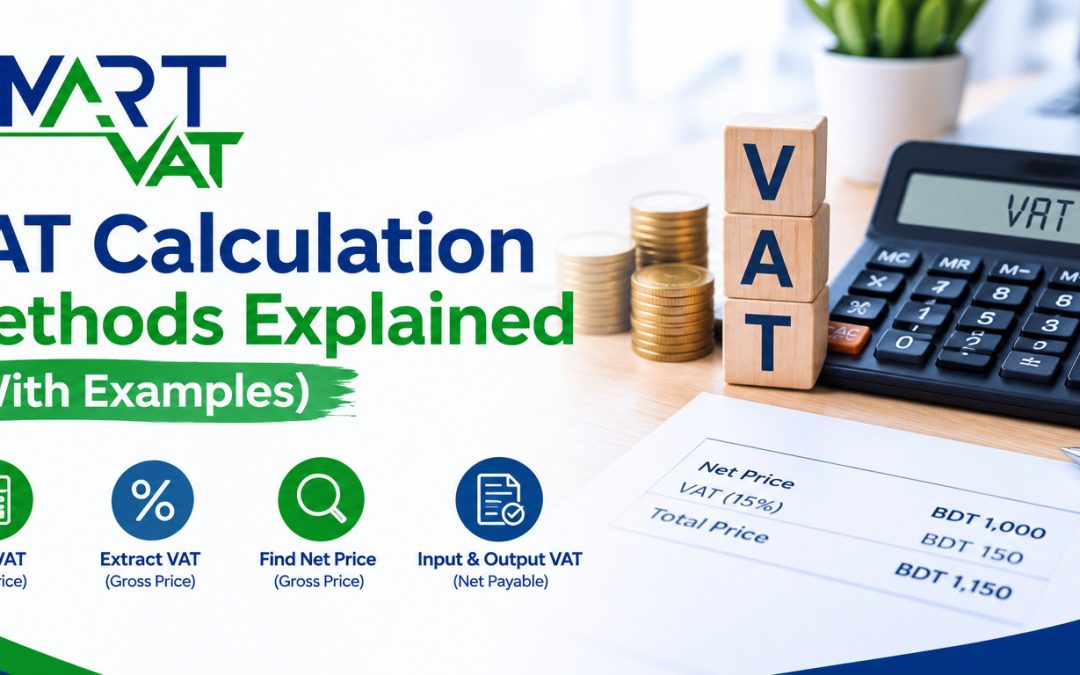
Example: Net price = BDT 1,000. VAT rate = 15% (illustrative).
- VAT = 1,000 × 15% = BDT 150
- Total price including VAT = 1,000 + 150 = BDT 1,150
Result: A BDT 1,000 net price becomes BDT 1,150 once 15% VAT is added.
Method 2: Extract VAT from a VAT-inclusive price
Use this method when the total already contains VAT and you need to know how much of it is tax.
VAT Amount = Gross Price × VAT Rate / (1 + VAT Rate)
Example: Gross price = BDT 1,150. VAT rate = 15% (illustrative).
- VAT = 1,150 × 15 / 115 = BDT 150
- Net price = 1,150 – 150 = BDT 1,000
Why you cannot simply multiply by 15%: The 15% was applied to the net price of BDT 1,000, not to BDT 1,150. Multiplying 1,150 by 15% gives BDT 172.50, which overstates the VAT. It would also leave a net price of BDT 977.50, and adding 15% back to that produces about BDT 1,124.13 rather than the original BDT 1,150. The numbers only reconcile when you divide by (1 + VAT Rate).
Method 3: Calculate the VAT-exclusive price from a VAT-inclusive total
This method finds the underlying price before VAT, which is useful when comparing supplier quotes or checking a margin.
Net Price = Gross Price / (1 + VAT Rate)
Example: Gross price = BDT 2,300. VAT rate = 15% (illustrative).
- Net price = 2,300 / 1.15 = BDT 2,000
- VAT amount = 2,300 – 2,000 = BDT 300
Result: The price before VAT is BDT 2,000, and BDT 300 of the total is VAT.
Method 4: Use the VAT tax fraction
The tax fraction is a shortcut for extracting VAT from a VAT-inclusive amount. It expresses the VAT portion of the gross price as a fraction.
Tax Fraction = VAT Rate / (100 + VAT Rate)
VAT Amount = Gross Price × VAT Rate / (100 + VAT Rate)
Example: Gross price = BDT 1,150. VAT rate = 15% (illustrative).
- Tax fraction = 15 / (100 + 15) = 15 / 115, which is about 0.1304
- VAT = 1,150 × 15 / 115 = BDT 150
How it relates to Method 2: Because Gross Price = Net Price × (1 + VAT Rate) and VAT = Net Price × VAT Rate, the VAT is always the fraction VAT Rate / (1 + VAT Rate) of the gross price. Written with percentages, that fraction is 15/115. Methods 2 and 4 are the same calculation in two notations.
Quick reference:
| Purpose | Formula | Use when |
|---|---|---|
| Add VAT to a net price | Net × (1 + Rate) | You have the price before VAT |
| Find VAT in a gross price | Gross × Rate / (1 + Rate) | You have the price including VAT |
| Find the net price | Gross / (1 + Rate) | You need the price before VAT |
| Tax fraction method | Gross × Rate / (100 + Rate) | You prefer the percentage form |
Input VAT vs Output VAT
Most VAT systems let a business offset the VAT it pays against the VAT it collects. Three terms describe the flow.
- Output VAT is the VAT charged, or required to be accounted for, on taxable sales.
- Input VAT is the VAT incurred on business purchases. It may qualify for credit or adjustment if the applicable conditions are met. Not every purchase automatically qualifies.
- Net VAT payable is what remains after permitted input tax credits and other adjustments are applied to output VAT.
Simplified Net VAT Payable = Output VAT – Eligible Input VAT
Simplified example: Output VAT = BDT 30,000. Eligible input VAT credit = BDT 12,000.
- Net VAT payable = 30,000 – 12,000 = BDT 18,000
Assumptions: This example assumes the input VAT is fully eligible for credit and that no additional adjustments, restrictions or other liabilities apply. In practice, eligibility depends on the legal conditions and supporting documents discussed in the Bangladesh section below.
VAT Calculation Examples for Different Business Situations
The following scenarios apply the methods above. All rates are illustrative at 15%, and all amounts are in BDT.
Example 1: A retailer prices a product before VAT
Scenario. A retailer wants to set a shelf price for a product that has a net selling price of BDT 4,500.
Given. Net price = BDT 4,500. Illustrative VAT rate = 15%.
Formula.
VAT Amount = Net Price × VAT Rate
Price Including VAT = Net Price + VAT Amount
Calculation.
- VAT = 4,500 × 15% = BDT 675
- Price including VAT = 4,500 + 675 = BDT 5,175
Final answer. The customer pays BDT 5,175, of which BDT 675 is VAT.
Business implication. The retailer must record BDT 4,500 as the sale value and BDT 675 as output VAT. The VAT is not additional revenue for the business.
Example 2: A business extracts VAT from a VAT-inclusive selling price
Scenario. A shop sells goods at a fixed VAT-inclusive price of BDT 8,625 and needs the VAT figure for its sales record.
Given. Gross price = BDT 8,625. Illustrative VAT rate = 15%.
Formula.
VAT Amount = Gross Price × 15 / 115
Net Price = Gross Price – VAT Amount
Calculation.
- VAT = 8,625 × 15 / 115 = 75 × 15 = BDT 1,125
- Net price = 8,625 – 1,125 = BDT 7,500
- Check: 7,500 × 1.15 = BDT 8,625
Final answer. VAT is BDT 1,125 and the net sale value is BDT 7,500.
Business implication. Reporting BDT 8,625 as revenue would overstate sales by the VAT amount, and applying 15% directly to BDT 8,625 would overstate the tax liability.
Example 3: A business estimates net VAT payable
Scenario. A trading business wants a quick estimate of its VAT position for one tax period.
Given. Net taxable sales = BDT 400,000. Net purchases that carry VAT = BDT 250,000. Illustrative VAT rate = 15%. Assume all purchases are eligible for credit.
Formula.
Output VAT = Net Sales × VAT Rate
Input VAT = Net Purchases × VAT Rate
Net VAT Payable = Output VAT – Eligible Input VAT
Calculation.
- Output VAT = 400,000 × 15% = BDT 60,000
- Input VAT = 250,000 × 15% = BDT 37,500
- Net VAT payable = 60,000 – 37,500 = BDT 22,500
Final answer. The simplified net VAT payable is BDT 22,500.
Business implication. Suppose BDT 50,000 of those purchases turns out to be ineligible, for example because a valid tax invoice is missing. The eligible input VAT falls to 37,500 – 7,500 = BDT 30,000, and the net payable rises to 60,000 – 30,000 = BDT 30,000. Checking eligibility before claiming credit protects the accuracy of the return.
Example 4: A discount and a return affect the taxable value
Scenario. A supplier gives a trade discount shown on the invoice, and the customer later returns part of the goods.
Given. List price (net) = BDT 10,000. Discount = 10%. Returned goods = BDT 3,000 of the discounted net value. Illustrative VAT rate = 15%.
Calculation.
- Discounted net value = 10,000 – 1,000 = BDT 9,000
- VAT on the invoice = 9,000 × 15% = BDT 1,350, so the invoice total is BDT 10,350
- VAT on the return = 3,000 × 15% = BDT 450, so the credit note total is BDT 3,450
- After the return: net sales = BDT 6,000, VAT = BDT 900, total = BDT 6,900
Final answer. The final taxable value is BDT 6,000 and the final VAT is BDT 900.
Business implication. VAT is generally based on the actual consideration for the supply, so the credit note should mirror the original invoice. Whether a specific discount reduces the taxable value depends on its nature and the applicable rules, so confirm the treatment before relying on this pattern.
How VAT Calculation Works in Bangladesh
The formulas above are mathematical. Whether they produce the right legal answer depends on Bangladesh’s VAT legislation, the rate that applies to the specific supply, the valuation rules and the input tax credit requirements. The statements below come from the NBR VAT FAQ, reviewed on 19 October 2026. The full law is published on the NBR page for VAT Acts.
Legal framework and rates
Bangladesh levies VAT under the Value Added Tax and Supplementary Duty Act 2012, administered by the NBR. According to the NBR, VAT is levied at 15% on taxable imports and supplies, except goods and services exempted under the First Schedule of the law. The NBR also states that exports are charged at 0%.
This does not mean one rate fits every transaction. The same NBR guidance describes exempt supplies, zero-rated supplies and supplementary duty, which is charged on specified goods and services listed in the Second Schedule. Small enterprises may fall under turnover tax instead of VAT, and some sectors have been subject to reduced or truncated-base rates set through SROs. Sources differ on the details, and the NBR FAQ page itself contains figures that appear to predate recent changes. For that reason this article does not state registration thresholds, turnover tax percentages or reduced rates. Check the current VAT SROs for the rate that applies to your product or service.
Valuation and the tax fraction
The NBR explains that the value of a supply is treated as VAT-inclusive, and that VAT is found by multiplying by the tax fraction. Its own example uses a restaurant meal priced at BDT 300, where VAT is 300 × 15/115 = BDT 39.13 and the value of the supply is BDT 260.87. This is the same logic as Methods 2 and 4 above. The NBR’s examples round to two decimal places, so choose a consistent rounding policy and apply it across all invoices.
Where supplementary duty also applies, the duty is part of the base on which VAT is calculated, so VAT and supplementary duty must be worked out in the correct order. The NBR FAQ includes a worked example for this case.
Net VAT payable under NBR guidance
The NBR’s full net tax formula is wider than the simplified version earlier in this article, because it includes adjustments:
Net Tax = Output Tax + Increasing Adjustment – Input Tax – Decreasing Adjustment
The NBR’s own illustration uses output tax of BDT 2,000, input tax of BDT 1,400, an increasing adjustment of BDT 300 and a decreasing adjustment of BDT 200. The result is 2,000 + 300 – 1,400 – 200 = BDT 700.
Input tax credit conditions
According to the NBR FAQ, the conditions for claiming input tax credit include the following:
- The purchase must relate to the business’s economic activities.
- The buyer has paid, or is liable to pay, the consideration for the supply.
- If the value of the taxable supply exceeds BDT 100,000, payment in whole or in part must be made through a banking channel.
- A valid tax invoice (Mushak 6.3) is required, or a Bill of Entry in the case of imports.
- Credit is claimed in the relevant tax period or within the following two tax periods.
The NBR also describes partial credit where purchases are used for both taxable and exempt supplies, and it explains that a supplier makes a decreasing adjustment and issues a credit note when goods are returned. VAT-related records should be preserved for five years according to the same source. These rules are changed from time to time, so confirm each condition against the current Act, Rules and instructions before filing. Return filing and payment are done through the NBR’s VAT online portal, where you should also confirm the current tax period and due date.
Common VAT Calculation Mistakes Businesses Should Avoid
The legal consequence of an error varies by jurisdiction and circumstance, but the practical causes are consistent. Each mistake below comes with a prevention step.
- Treating a VAT-inclusive price as VAT-exclusive. Applying the rate to a gross total overstates VAT. Prevention: label every price as inclusive or exclusive and use the division methods for gross amounts.
- Confusing the VAT amount with the total price. Invoices should show net value, VAT and gross total on separate lines. Prevention: use an invoice template with all three fields.
- Using an incorrect or outdated rate. Rates and SROs change, and different products can carry different treatments. Prevention: assign the rate per product or service code and review it when official notices are issued.
- Applying the wrong taxable value. Discounts, supplementary duty and bundled supplies can change the base. Prevention: document how the taxable value is determined for each product line.
- Claiming input VAT without checking eligibility. Missing tax invoices or non-compliant payments can make a credit invalid. Prevention: check the invoice and payment method before the credit is recorded.
- Ignoring adjustments, returns, discounts or exemptions. Credit notes and adjustments must flow into the return. Prevention: process returns through formal credit notes, not manual edits.
- Using inconsistent rounding. Rounding line by line in one report and invoice by invoice in another creates small differences that add up. Prevention: set one rounding policy and apply it everywhere.
- Failing to reconcile sales and purchase records. Differences between the ledger and the invoices often surface only at filing time. Prevention: reconcile every period before preparing the return. SmartVAT has a useful explainer on VAT reconciliation.
How VAT Software Can Improve Calculation Accuracy
Spreadsheets work for a handful of invoices, but manual VAT calculation becomes harder as transaction volumes, branches and product categories grow. Suitable VAT software can help in several ways:
- It applies configured tax rules consistently to every transaction.
- It reduces repetitive data entry and manual calculation.
- It keeps invoices and transaction records in a structured form.
- It makes it easier to reconcile sales and purchase data.
- It supports reporting workflows by drawing from the same underlying records.
- It highlights potential discrepancies earlier.
Software does not guarantee compliance on its own. Results still depend on correct configuration, valid source data, user oversight and keeping the tax rules up to date.
For businesses that need more structured VAT management, VAT management software for businesses such as SmartVAT is one option to evaluate. According to the product page, SmartVAT calculates VAT on sales and purchase transactions, tracks input and output tax, generates Mushak forms including 9.1, and keeps an audit trail. It also describes API-based integration with ERP, accounting and POS systems. These descriptions come from the vendor, so test them against your own workflow in a demo. You can read more in the SmartVAT overview and in this article on why businesses adopt VAT automation software.
Conclusion
VAT calculation comes down to knowing which amount you are starting from. Multiply the net price by the rate to add VAT. Divide the gross price by (1 + rate), or use the tax fraction, to take VAT out. Output VAT minus eligible input VAT gives a simplified net VAT payable, and in Bangladesh the full figure also depends on adjustments, tax invoices, payment rules and the rate that applies to each supply.
The reliable habits are the same everywhere: use the correct taxable amount, confirm the current rate, keep complete documentation, check credit eligibility and reconcile records every period. If your team is outgrowing spreadsheets, you can learn more about structured VAT management through SmartVAT’s VAT management solution.
Frequently Asked Questions
How do you calculate VAT on a price?
If the price excludes VAT, multiply the net price by the VAT rate. For example, at an illustrative 15% rate, BDT 1,000 × 15% = BDT 150 of VAT, so the VAT-inclusive price is BDT 1,150. Always confirm the rate that applies to the specific good or service under the relevant tax law before invoicing.
How do you calculate VAT from a VAT-inclusive price?
Divide rather than multiply. VAT = Gross Price × Rate / (1 + Rate). At an illustrative 15% rate, a gross price of BDT 1,150 contains BDT 150 of VAT, leaving a net price of BDT 1,000. Multiplying 1,150 by 15% would give BDT 172.50, which overstates the tax.
What is the formula for VAT calculation?
The core formula is VAT Amount = Net Price × VAT Rate, and the VAT-inclusive price is Net Price × (1 + VAT Rate). To work backwards from a total, use Net Price = Gross Price / (1 + VAT Rate). These are mathematical relationships. The rate and taxable value come from the applicable law.
How do you calculate VAT using the tax fraction?
The tax fraction converts a VAT-inclusive amount into its VAT portion. It equals Rate / (100 + Rate), which is 15/115 at an illustrative 15% rate. Multiply the gross price by this fraction. For BDT 1,150, the VAT is BDT 150. NBR’s VAT FAQ uses the same 15/115 approach in its examples.
What are common VAT compliance mistakes?
Common mistakes include wrong or outdated rates, incomplete tax invoices, mismatched input and output VAT, spreadsheet errors, missing documents, late reconciliation and inconsistent data across accounting, ERP, POS and VAT systems. Most are process failures that regular reconciliation catches early.
What is the difference between input VAT and output VAT?
Output VAT is the VAT charged on taxable sales. Input VAT is the VAT paid on business purchases, which may be credited against output VAT if the legal conditions are met. In Bangladesh, factors such as a valid tax invoice and the payment method affect whether a credit is allowed.
How is net VAT payable calculated?
In simplified form, net VAT payable equals output VAT minus eligible input VAT. If output VAT is BDT 30,000 and eligible input VAT is BDT 12,000, the result is BDT 18,000. Under NBR guidance, the full calculation also includes increasing and decreasing adjustments, so check the current rules before filing.
Does the same VAT rate apply to all goods and services in Bangladesh?
No. The NBR’s VAT FAQ states a standard rate of 15% for taxable imports and supplies, 0% for exports, and exemptions for items in the First Schedule. Supplementary duty can apply on top for specified items, and special regimes exist. Confirm the treatment of each product or service against current official sources.