
Author

A small trading business with a handful of monthly invoices can usually manage VAT on a spreadsheet without much trouble. The moment that same business adds a second branch, a new product line, a few hundred more customers, or a supplier list that changes every quarter, the spreadsheet starts working against it instead of for it. Formulas break, figures get typed in twice, and someone has to spend a weekend reconciling numbers before a filing deadline.
This is the point where many businesses in Bangladesh start looking at VAT automation software. The core difference between manual VAT management and an automated system is not just speed. It is consistency: an automated system applies the same rules, the same calculations and the same reporting logic to every transaction, every time, regardless of how many transactions there are.
This article looks at why that difference matters, what problems VAT automation software actually solves, and how businesses can evaluate whether it is the right move for their own operations.
What Is VAT Automation Software?
VAT automation software is a digital system that calculates VAT on sales and purchase transactions, tracks input and output tax, generates VAT reports and return forms, and maintains compliance records automatically instead of relying on manual entry and spreadsheet formulas. It reduces repetitive manual work and helps keep VAT data accurate and consistent as transaction volume grows.
A more detailed walkthrough of how this type of software works, including the mechanics of automated filing, is covered in What Is VAT Automation Software? A Clear Guide and How Does Automated VAT Filing Work? A Complete Guide. This article focuses specifically on why businesses adopt it in the first place.
Why Do Businesses Need VAT Automation Software?
Businesses need VAT automation software because manual VAT processes do not scale cleanly. As the number of transactions, branches, products and suppliers increases, manual calculation, spreadsheet reconciliation and paper-based recordkeeping become slower, more error-prone and harder to audit. Automation keeps VAT accurate and consistent regardless of volume.
The sections below break this down into the specific business problems that drive the decision to automate.
Reducing Manual Calculation Errors
VAT calculation looks simple on paper: apply the applicable rate to the transaction value. In practice, a business dealing with multiple VAT rates, supplementary duties, exemptions and adjustments across hundreds of transactions is relying on someone to apply the correct rule every single time, without exception. A single mistyped figure or a formula that was not updated after a rate change can throw off an entire VAT return.
VAT automation software applies calculation rules consistently across every transaction, which removes the dependency on one person getting every entry right by hand. This matters because a calculation error is rarely caught in isolation. It usually surfaces later, during reconciliation or an audit, when it is harder and more time-consuming to trace back to its source.
Saving Time on VAT Reporting, Mushak Preparation and Return Filing
Preparing VAT reports and Mushak forms manually means pulling data from multiple sources, formatting it correctly, and checking it against previous filings before submission. For a business with a modest transaction volume, this might take a few hours each period. For a business with a high volume of sales and purchase transactions across multiple product lines, it can consume days of finance team time that could be spent on analysis instead of data entry.
Automated systems generate the required VAT return forms and reports directly from transaction data, which removes most of the manual formatting and cross-checking work. This does not eliminate the need for a finance team to review the output, but it changes their role from data entry to verification, which is a meaningfully different use of their time.
Keeping VAT Data Consistent Across Transactions
When VAT data is entered manually across multiple spreadsheets, invoices and branch records, small inconsistencies build up over time. A product might be coded under a different VAT treatment in one branch than another, or a discount might be applied to the VAT base inconsistently. None of these errors are dramatic on their own, but together they make it difficult to trust the final numbers.
VAT automation software applies a single, consistent set of rules to every transaction that flows through it, regardless of which branch, product or user generated the transaction. This consistency is one of the more underappreciated benefits of automation because it does not just prevent errors, it makes VAT data reliable enough to use for business decisions, not just compliance.
Managing Input and Output VAT Tracking and Reconciliation
Every VAT-registered business has to track VAT paid on purchases (input VAT) and VAT collected on sales (output VAT), then reconcile the two to determine the net VAT payable. Done manually, this means matching purchase invoices against supplier records and sales invoices against customer records, often across separate systems that do not talk to each other.
Automated VAT software matches input and output VAT as transactions are recorded, which keeps the reconciliation current instead of something that only gets done right before a filing deadline. This is particularly valuable for businesses with a high volume of purchase transactions, such as manufacturers and traders, where manual reconciliation is one of the most time-consuming parts of the VAT cycle.
Maintaining Compliance Records and Audit Readiness
VAT compliance is not just about filing returns correctly. It also requires maintaining records that can be produced if the National Board of Revenue (NBR) requests them, sometimes years after the original transaction. Manual recordkeeping, especially paper-based or scattered across spreadsheets, makes this difficult. Documents get lost, formats change over time, and reconstructing a clear transaction history becomes a research project rather than a quick lookup.
VAT automation software keeps a digital, structured record of every transaction, calculation and filing, with an audit trail that shows how each figure was derived. This does not remove the responsibility of maintaining accurate records under the VAT and Supplementary Duty Act, 2012, but it does make those records far easier to retrieve and verify when they are needed.
Managing VAT Across Multiple Branches
A single-location business can usually keep VAT management centralized, even if it is manual. A business with multiple branches, warehouses or retail outlets faces a different problem: VAT data is generated in several places at once, and someone has to consolidate it into a single, accurate picture for reporting purposes.
Manual consolidation across branches introduces delays and version-control problems, since each branch may be working from its own spreadsheet or ledger. VAT automation software that supports multi-branch VAT management brings this data into one platform, so consolidated and location-specific reports can be generated without manually merging files from each site.
Connecting VAT Data With ERP, Accounting and POS Systems
Many businesses already run an ERP, accounting or point-of-sale system that captures sales and purchase data. When VAT is calculated separately from these systems, someone has to re-enter or re-export data between them, which introduces both extra work and additional room for error.
VAT automation software that integrates with ERP, accounting and POS systems through APIs keeps VAT data in sync with the rest of the business automatically, without manual data transfer between platforms. This is particularly relevant for businesses evaluating VAT management software that needs to fit into an existing technology setup rather than replace it entirely.
Getting Real-Time VAT Visibility
With manual processes, VAT liability is often only calculated at the end of a reporting period, which means a business does not have a clear, current view of what it owes or has already paid until the reports are finished. This makes it harder to plan cash flow around VAT payments or catch discrepancies early.
Automated systems calculate VAT as transactions happen, which gives finance teams and management a real-time view of VAT payable, input and output tax positions, and transaction history at any point in the period, not just at filing time.
Scaling VAT Operations as the Business Grows
A VAT process that works for a business with a few hundred monthly transactions will not necessarily hold up when that volume grows tenfold. Manual processes tend to scale linearly at best: twice the transactions usually means close to twice the manual work, and often more, since error rates and reconciliation complexity tend to increase with volume rather than stay flat.
VAT automation software is built to handle growing transaction volume without a proportional increase in manual effort, which is one of the main reasons businesses adopt it before their existing process breaks down rather than after.
Manual VAT Management vs VAT Automation
Manual VAT Management:
- VAT calculated by hand or through spreadsheet formulas that need to be maintained and checked
- VAT reports and Mushak forms compiled manually before each filing
- Input and output VAT reconciled periodically, often close to a deadline
- Compliance records stored across spreadsheets, paper files or disconnected systems
- Multi-branch data consolidated manually from separate files
- VAT data disconnected from ERP, accounting and POS systems
- VAT position only clear once reports are finished
VAT Automation:
- VAT calculated automatically and consistently on every transaction
- VAT reports and return forms generated directly from transaction data
- Input and output VAT matched and reconciled continuously
- Compliance records maintained digitally with a traceable audit trail
- Multi-branch data consolidated automatically in one platform
- VAT data synced with ERP, accounting and POS systems through integration
- VAT position visible in real time throughout the period
The practical difference is not that manual VAT management is impossible. Many businesses run it successfully at a small scale. The difference shows up as complexity increases: automation is built to absorb that complexity without a proportional increase in manual effort, while manual processes tend to strain under it.
Which Businesses Can Benefit From VAT Automation Software?
VAT automation software is relevant to a wide range of businesses, including retail, FMCG, manufacturing, furniture, pharmaceutical, chemical, trading, hospitality and restaurant businesses, as well as any multi-branch or growing enterprise. What determines the actual benefit is not company size alone, but transaction complexity, reporting requirements and operational structure.
An FMCG distributor handling a high volume of small transactions across many customers has different VAT tracking needs than a manufacturer working with fewer, larger transactions but a complex input tax structure across raw materials. A furniture business with production and multiple showrooms has to manage VAT across both manufacturing and retail stages. A restaurant or hospitality business processes a continuous stream of point-of-sale transactions that need to feed into VAT reporting without manual re-entry.
A real-world example of how this plays out in a manufacturing and retail context is documented in the Partex VAT software case study, which covers a furniture industry implementation.
In general, a business is a strong candidate for VAT automation when it is managing more than a small, stable number of monthly transactions, operating across multiple locations, working with several VAT rates or exemptions, or finding that VAT reporting is consistently taking up more finance team time than it should.
What Should Businesses Look for in VAT Automation Software?
Not every VAT automation platform offers the same capabilities, so it is worth evaluating a system against the specific problems it needs to solve rather than assuming all providers are equivalent. Relevant evaluation criteria include:
- Automated VAT calculation across applicable rates and rules
- VAT reporting and Mushak form generation
- VAT return preparation aligned with current NBR formats
- Input and output VAT tracking and reconciliation
- A clear, retrievable audit trail for compliance and audit purposes
- Real-time reporting rather than end-of-period reporting only
- Support for multi-branch operations, where relevant
- Integration with existing ERP, accounting and POS systems
- Data security and access controls
- Ease of use for finance and accounts staff, not just IT teams
- Ability to scale as transaction volume grows
- Alignment with applicable Bangladesh VAT requirements under the VAT and Supplementary Duty Act, 2012
Not every VAT software provider will support every item on this list to the same depth, so businesses should confirm specific capabilities, such as which Mushak forms are supported or which ERP systems can be integrated, before making a decision.
How VAT Automation Supports Better Business Operations
The effect of VAT automation extends beyond the finance function. Accounts teams spend less time on repetitive data entry and more time reviewing and verifying figures. Compliance teams have a clearer, more current record to work from when preparing for filings or responding to NBR queries. Branch operations benefit from not having to maintain separate VAT records that someone else has to consolidate later.
For management, consistent and real-time VAT data supports better decision-making, since VAT liability and input-output positions are visible throughout the period rather than only after reports are compiled. Reporting itself becomes faster to produce and easier to trust, since it is generated from a single, consistent data source rather than assembled from multiple manual inputs.
Why VAT Automation Matters More as a Business Grows
The relationship between transaction volume and VAT management difficulty is not linear. A business processing a small, stable number of transactions each month can often manage VAT manually without significant strain. As that same business adds branches, expands its product range, brings on more suppliers and customers, or increases its transaction frequency, the operational complexity of manual VAT management tends to grow faster than the transaction volume itself, since more time is needed for coordination, reconciliation and error-checking across a larger and more varied dataset.
This is why many businesses find that VAT automation becomes more valuable, not less, as they grow. A process that was manageable at a smaller scale can become a genuine operational bottleneck once transaction complexity increases, and automation is designed specifically to absorb that added complexity.
Is VAT Automation Software Worth It for a Growing Business?
For a growing business, VAT automation software is generally worth evaluating, though the right decision depends on the specific business. The potential benefits include time savings on reporting and reconciliation, reduced repetitive manual work, more consistent VAT data, easier compliance recordkeeping, and better visibility into VAT positions throughout the period.
At the same time, businesses should evaluate their own transaction volume, workflow complexity, integration requirements and compliance needs before selecting a solution, since the value of automation is closely tied to how much manual effort it actually removes from the specific process a business is running today.
If your business is still relying on spreadsheets or manual VAT processes and finding that VAT reporting takes up more time each period than it used to, it is worth exploring where automation could realistically simplify that workflow, rather than assuming any one system is a universal fix.
SmartVAT for Automated VAT Management
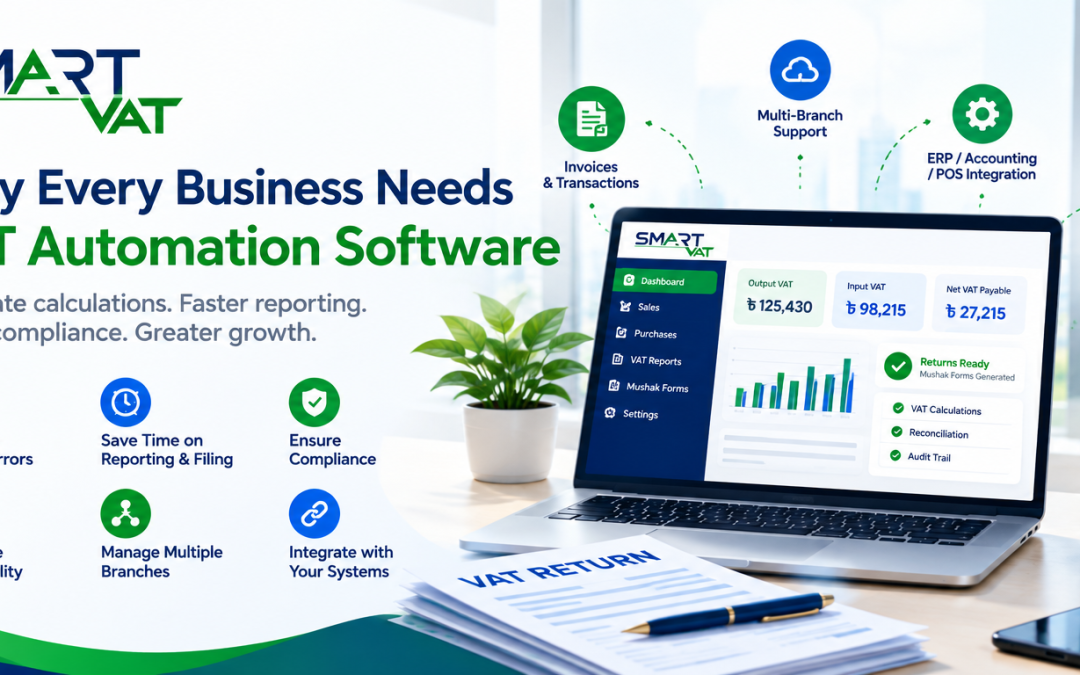
SmartVAT is one example of a VAT management software built for the Bangladesh market. According to SmartVAT’s own information, the platform is enlisted by the National Board of Revenue and designed to operate in line with the VAT and Supplementary Duty Act, 2012.
SmartVAT covers VAT calculation, VAT reporting, VAT return preparation and Mushak form generation, including forms such as Mushak 9.1 and 9.2, alongside input and output VAT management. It is built to integrate with third-party ERP, accounting and POS systems through API, so VAT data can stay connected to a business’s existing software rather than sitting in a separate system. The platform also supports multi-branch operations, which is relevant for businesses managing VAT across more than one location.
This mirrors the broader case for automation covered throughout this article: businesses turn to tools like the SmartVAT solution for automated VAT management specifically to address the calculation accuracy, reporting speed, reconciliation and multi-branch challenges described above, rather than adopting software for its own sake.
Businesses evaluating a VAT management system for their own operations can request a demo or get in touch to discuss how a platform like SmartVAT would fit their specific transaction volume and reporting requirements.
Frequently Asked Questions
Why do businesses need VAT automation software?
Businesses need VAT automation software because manual VAT processes, including calculation, reporting and reconciliation, become slower and more error-prone as transaction volume, branches and product lines increase. Automation keeps VAT data accurate and consistent regardless of scale.
What is VAT automation software?
VAT automation software is a digital system that calculates VAT on transactions, tracks input and output tax, generates VAT reports and return forms, and maintains compliance records automatically, reducing the manual work involved in spreadsheet-based VAT management.
How does VAT automation reduce manual errors?
It applies the same calculation rules consistently to every transaction, removing the dependency on manual data entry and formulas that can break or go uncorrected as volume grows.
Can VAT software help with VAT return preparation?
Yes. VAT automation software generates VAT return forms, including Mushak forms, directly from recorded transaction data, which reduces the manual formatting and cross-checking involved in preparing returns by hand.
Is VAT automation useful for small businesses?
It can be, though the benefit depends more on transaction volume, number of VAT rates involved and reporting complexity than on business size alone. A small business with straightforward, low-volume transactions may manage well manually, while a growing business may benefit sooner than expected.
Can VAT software integrate with ERP and accounting systems?
Many VAT automation platforms, including SmartVAT, are built to integrate with third-party ERP, accounting and POS systems through API, keeping VAT data synced with the rest of the business without manual data transfer.
How does VAT automation help businesses prepare for audits?
It maintains a digital, structured audit trail of every transaction, calculation and filing, which makes it easier to retrieve and verify records if the National Board of Revenue requests them.
What should a business consider before choosing VAT software?
Businesses should look at calculation accuracy, reporting and Mushak form generation, reconciliation capabilities, audit trail quality, ERP and accounting integration, multi-branch support, data security, ease of use and scalability, and should confirm which of these each specific provider actually supports.